Stablecoin adoption is growing. So are AML Compliance challenges
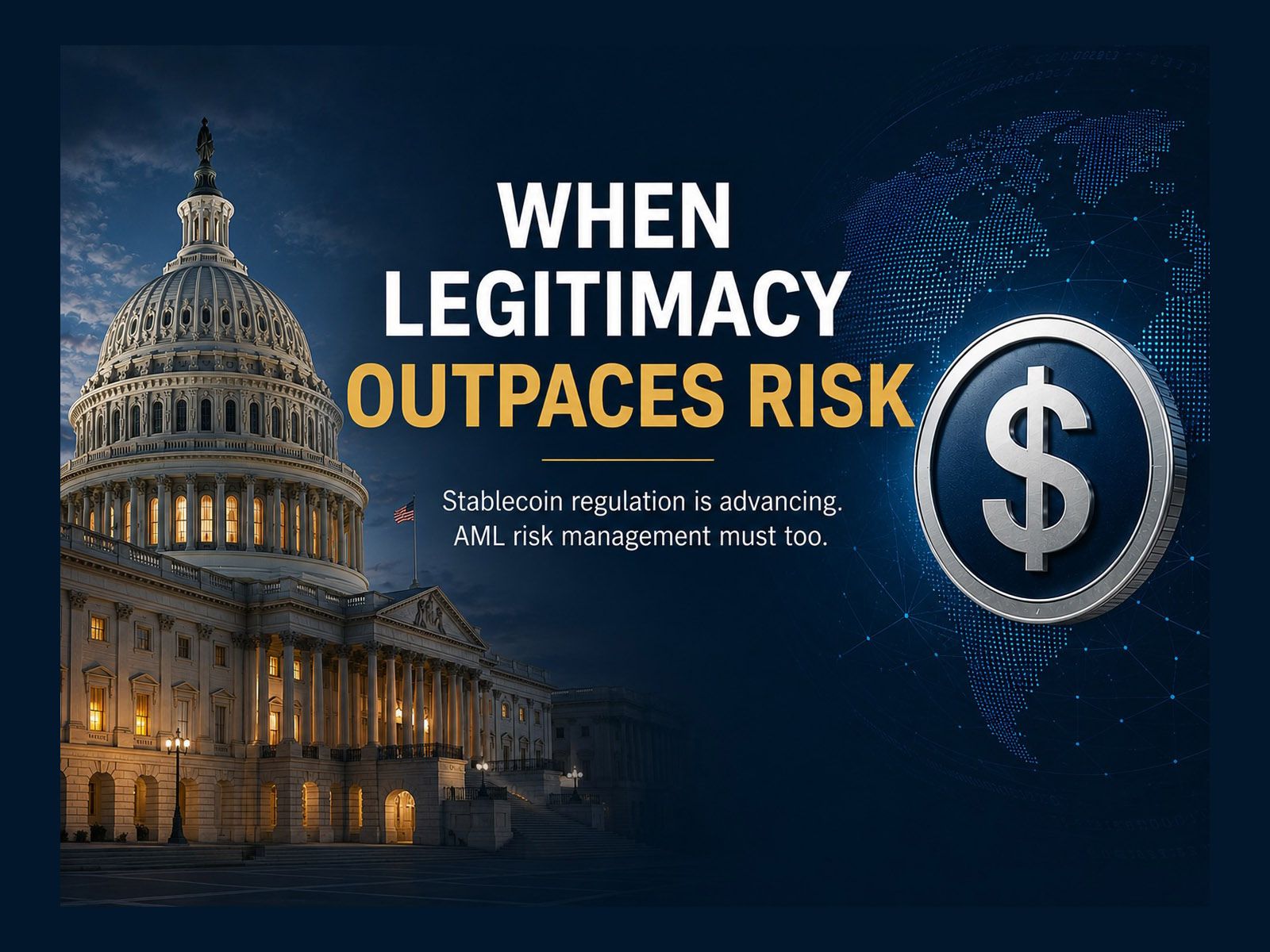
Stablecoins have spent years operating at the edge of the financial system. That is changing rapidly. And now stablecoin regulation and AML Compliance need to catch up.
New legislation, growing institutional adoption, and sustained lobbying efforts from the digital asset industry have moved stablecoins from a niche cryptocurrency product toward mainstream financial infrastructure.
Policymakers increasingly discuss stablecoins as tools for innovation, payment modernization, and maintaining U.S. competitiveness in digital finance. Recent legislation such as the GENIUS Act has created the first comprehensive federal framework for payment stablecoins, accelerating the industry’s path toward broader adoption.
For compliance professionals, however, an important question remains:
Does growing legitimacy reduce financial crime risk, or simply make stablecoins more widely available?
The answer matters because the same characteristics that make stablecoins attractive for legitimate commerce continue to make them attractive to illicit actors.
Stablecoins are becoming part of mainstream finance
The stablecoin conversation has changed significantly over the past two years.
The industry is no longer focused solely on proving the technology works. The discussion now centers on how stablecoins can support payments, settlement, treasury management, and cross-border transactions. Policymakers in the United States, Europe, and the United Kingdom are actively debating how best to regulate stablecoins while encouraging innovation.
Industry advocates have spent years arguing that regulatory clarity would encourage adoption while reducing uncertainty. That effort has largely succeeded. Many policymakers and market users now view stablecoins as a permanent component of the future financial system.
None of that growing embrace faces up well to the risks of money laundering and terror financing. Compliance teams should recognize that regulatory acceptance and risk reduction are not always the same thing.
Why stablecoins present substantial AML risk
Stablecoins offer several advantages over traditional payment mechanisms:
- Near-instant settlement
- Global accessibility
- 24-hour availability
- Cross-border transferability
- Reduced dependence on traditional banking infrastructure
Those benefits create legitimate business value. They also create value for criminal organizations seeking to move funds across borders, avoid delays, or exploit jurisdictional complexity.
This reality is increasingly reflected in blockchain intelligence data. Chainalysis reported that stablecoins accounted for approximately 84 percent of illicit cryptocurrency transaction volume in 2025, making them the dominant medium for illicit crypto activity. Criminal organizations favor stablecoins for many of the same reasons legitimate users do: transferability, stability, and utility across multiple jurisdictions.
TRM Labs similarly reported that stablecoins have become a primary connective layer within global illicit finance networks, facilitating activity across sanctions evasion schemes, underground banking systems, fraud operations, and transnational criminal organizations.
The challenge for AML programs is straightforward: Wider adoption often creates a larger environment in which illicit activity can occur.
The AML Compliance challenge of legitimacy
History provides many examples of products being accepted faster than their risks become fully understood. No-contact wires are a good example of this. Like stablecoin, they have a lot of utility and bring a lot of risk.
Regulatory frameworks are essential. They improve transparency, establish standards, and create supervisory expectations. But regulation does not eliminate the underlying characteristics that make a product attractive to illicit actors.
The current stablecoin debate illustrates this challenge.
Years of lobbying and policy advocacy have successfully shifted much of the public discussion from illicit finance concerns toward innovation, efficiency, and competitiveness. The very name of the US legislation–the GENIUS Act–bears out this attitudinal transformation. While these benefits of innovation and efficiency may be real, compliance leaders should be careful not to make the shift toward acceptance without a proportional accounting for the risk.
Financial crime risk does not disappear because a technology gains regulatory approval. In many cases, broader legitimacy simply expands the scale at which risk must be managed.
Stablecoin regulation and AML Compliance: What financial institutions should be preparing for now
As stablecoins become increasingly integrated into financial services, institutions will face familiar compliance questions in new operational environments.
Organizations will need to determine elements like the following:
- How beneficial ownership will be verified across increasingly complex structures
- How sanctions exposure can be identified and monitored
- How wallet activity, exchanges, and counterparties can be investigated effectively
- How risk assessments should evolve as stablecoin usage grow
- How decisions can be documented and defended during examinations
These are not merely regulatory questions. They are operational questions requiring visibility across onboarding, monitoring, investigations, screening, and case management processes.
As digital assets become more deeply connected to traditional financial services, fragmented compliance operations create growing exposure.
Regulatory acceptance does not eliminate AML obligations
Stablecoins are likely to remain a significant part of the financial landscape. And its obvious that the policy debate has largely shifted from whether stablecoins should exist to how they should be governed. That shift represents a major milestone for the industry.
It’s also true that stablecoin regulation and AML Compliance need to remain a significant part of the landscape. For AML and compliance professionals, the core responsibility remains unchanged. Regulatory acceptance should not be mistaken for assurance. If anything, broader adoption means compliance programs must be prepared to identify, investigate, and manage those risks at greater scale than ever before.