AML Compliance doesn’t fail in theory–it fails in execution
Policies exist. Risk models exist. Procedures exist.
Yet enforcement actions continue across the financial industry.
The problem is rarely the design of a compliance program. Most institutions have well-developed policies, documented procedures, and experienced Compliance professionals.
Where compliance breaks down is execution. Between policy and action sits a long operational chain — investigators gathering information, systems pulling data, documentation being assembled, reviews being conducted, and decisions being recorded. Every step introduces the possibility of inconsistency, delay, or error.
Compliance programs do not fail because institutions lack rules. They fail because those rules are not executed consistently.
The missing layer in AML Compliance technology
The financial industry has spent years investing in detection. Transaction monitoring systems generate alerts. Case management tools organize investigations. Data platforms aggregate information.
But detection is only the beginning of the process.
The real operational burden of compliance occurs after an alert is generated. Analysts must collect information, validate activity, confirm documentation, and ensure procedures are followed. Much of that work still depends on manual effort spread across multiple systems.
This creates unavoidable operational risk:
• Steps may be skipped or applied inconsistently.
• Documentation may be incomplete.
• Evidence chains may be difficult to reconstruct.
• Control gaps may appear between systems.
None of these challenges reflect a lack of diligence by Compliance professionals. They reflect the structural limitations of systems that stop at analysis instead of execution.
Compliance requires orchestration–and execution
What compliance programs actually require is operational orchestration.
Every step of a compliance workflow should be structured, governed, and executed in a controlled sequence across systems, teams, and data sources.
But orchestration alone is not enough. The critical capability is execution. This is where robotic process automation (RPA) plays a foundational role.
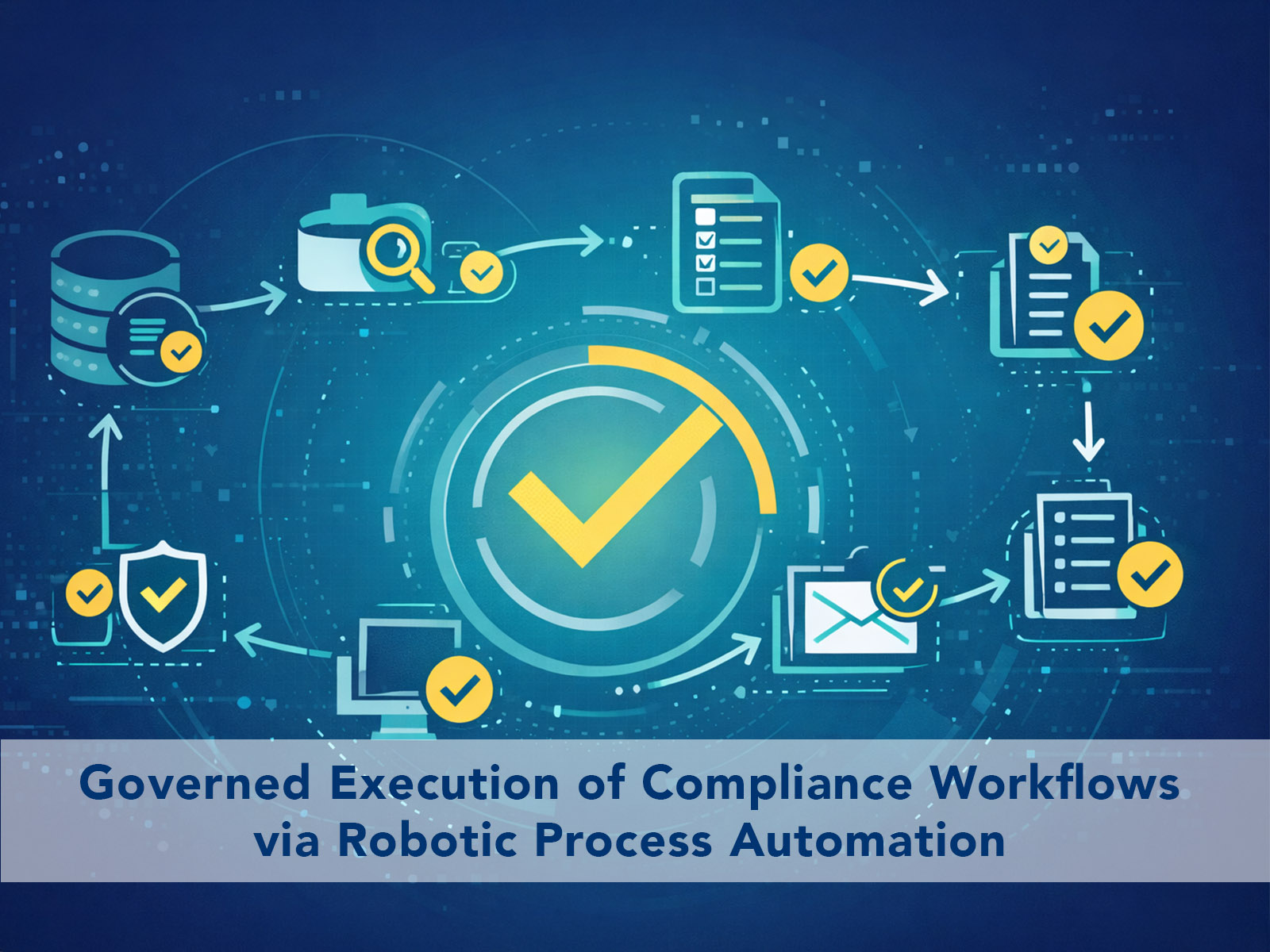
Within RegTechONE, RPA performs the operational steps of compliance workflows directly — gathering data, validating conditions, initiating actions, documenting outcomes, and advancing processes according to institutional policy.
When workflows execute automatically:
• procedures run exactly as defined
• required steps cannot be skipped
• documentation is generated as the work occurs
• evidence is preserved
• control gaps disappear
In practical terms, the compliance program runs the way it was designed to run.
The RPA foundation beneath the AI conversation
Much of the technology conversation today focuses on agentic AI and autonomous systems. These developments are exciting and will shape the future of financial crime prevention.
But autonomous systems require a stable operational foundation.
Before intelligence can guide decisions, systems must be able to execute those decisions reliably and consistently. Governed automation provides that foundation.
Robotic process automation represents the first practical layer of machine learning in compliance operations — structured execution based on defined institutional rules and policies.
Without reliable execution, intelligence has nowhere to operate.
The power of proving legitimate activity
Ultimately, a compliance program exists to answer a simple question: Is this activity legitimate?
The challenge is that legitimacy must be demonstrated. That requires documentation, verification, and evidence.
When workflows execute automatically and consistently, institutions can close the loop on legitimate business activity. Documentation is generated in real time. Evidence chains remain intact. Decisions are provable.
And when legitimate activity is fully accounted for, what remains becomes much easier to identify.
That is when institutions find the crime.
Compliance that governs itself
The goal of modern compliance technology should not simply be faster investigations or more alerts.
It should be governed execution.
When an AML Compliance platform orchestrates workflows and executes them through governed automation, the institution gains something far more powerful than efficiency. It gains a compliance program that runs exactly as designed–with transparency, documentation, and provability built into every step.