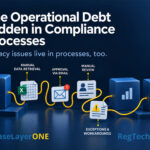
Digital tools, legacy behavior: The compliance trap to escape now
Across the financial industry, most institutions describe themselves as being on a “digital transformation journey.” But too often, what they mean is that they have moved their old manual processes into new digital wrappers—an online form here, a document management system there, a case tracker that still depends on emails and spreadsheets to fill the gaps.
This isn’t AML digital transformation. It’s digitization. And the difference matters—especially in AML and financial crime compliance, where the illusion of digital maturity can conceal deep operational risks and escalating costs.
The illusion of progress in digital transformation
Institutions that are “almost digital” typically have a patchwork of partially automated tools: a customer onboarding system, a separate transaction-monitoring engine, maybe even a third-party case manager. Each solves a local problem, but collectively they replicate the same fragmentation that manual systems created. Data remains siloed. Investigators still reconcile information across screens. Supervisors still chase context and consistency.
From the outside, these environments appear modern—dashboards, workflows, and digital records. But under the surface, the same vulnerabilities persist:
•Human workarounds that create unlogged decision points.
•Data inconsistencies that erode risk scoring accuracy.
•Update delays whenever new regulatory requirements arise.
It’s the worst of both worlds—modern tools, legacy behavior.
The real meaning of digital transformation in compliance
True digital transformation means the entire compliance operation—data, workflows, and risk logic—operates as one coherent system. It’s not just about automating tasks. It’s about unifying the enterprise’s compliance intelligence so that every action is traceable, every rule change is instantly deployable, and every decision is based on complete, orchestrated data.
Transformation is achieved when an institution can answer “yes” to these questions:
•Can every compliance process, from onboarding to SAR filing, be traced end-to-end within one platform?
•Can new regulatory obligations be implemented through configuration rather than coding?
•Can investigators see the same risk data, in real time, across every related case?
If the answer to any of these is “no,” the institution isn’t yet transformed. It’s still operating in a hybrid of automation and fragmentation—where operational drag and compliance risk quietly accumulate.
Data orchestration: The tipping point for AML digital transformation
The decisive factor in digital transformation in AML Compliance is data orchestration—the ability to unify and govern data flows across systems, vendors, and processes. Without orchestration, compliance automation is superficial. With it, automation becomes intelligent.
When a compliance platform orchestrates data, investigators aren’t toggling between systems or manually verifying identities; the system ensures data consistency from onboarding through monitoring to reporting. Alerts arrive with complete context. Case management operates on shared truth. Quality assurance becomes continuous.
This is the inflection point where digital tools stop creating more complexity and start creating measurable control.
The measurable outcomes of compliance transformation
Institutions that achieve full digital transformation report changes that are both quantitative and cultural. Improvements include the following:
•Reduced manual effort: Routine tasks—document retrieval, list screening, case assignment—run automatically, freeing skilled staff for complex analysis.
•Improved audit readiness: Every decision is captured within the workflow, building an always-on audit trail.
•Faster onboarding and investigations: Unified data eliminates rework and accelerates decision cycles.
•Regulatory agility: No-code configuration allows institutions to align with new obligations in days rather than quarters.
Perhaps most importantly, these institutions gain the ability to scale compliance without scaling headcount—a transformation in both efficiency and resilience.
The cost of standing still in AML Compliance operations
The institutions most at risk are those that believe they have already transformed because they digitized. Their legacy systems have new interfaces, but their teams are still managing exceptions by email, copying data between screens, and waiting on IT for every rule change.
The cost of this “almost digital” posture is hidden but relentless:
•Every manual reconciliation consumes staff hours.
•Every untracked override creates audit exposure.
•Every patchwork integration increases vendor dependence.
These aren’t line-item costs—they’re operational liabilities that erode competitiveness over time.
The RegTechONE model of digital transformation
In the RegTechONE platform, digital transformation is neither a slogan nor a future state—it’s operational reality in a unified compliance platform. RegTechONE unifies workflows, data, and risk management in a single no-code environment. Compliance teams can automate routine processes, orchestrate data across internal and external systems, and adapt instantly to regulatory change—all without custom development.
The result is not just efficiency but institutional agility: a compliance operation that learns, adapts, and scales in step with the business it protects.
The biggest takeaway
RegTech digital transformation is not a milestone; it’s a structural change in how compliance work gets done. The institutions that recognize this difference—and move beyond “almost digital”—will define the next generation of AML and financial crime compliance.