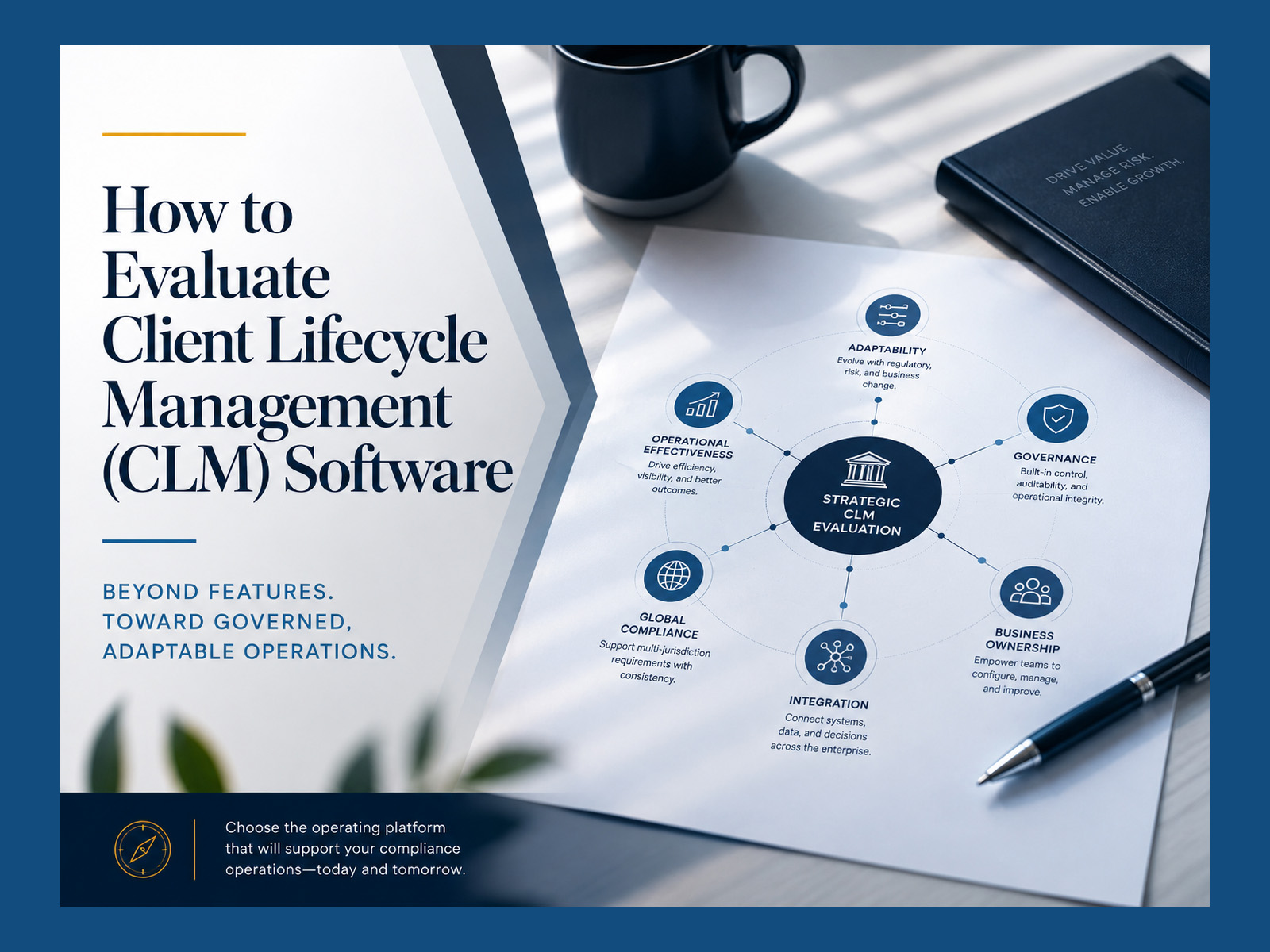
Choosing wisely among Client Lifecycle Management (CLM) platform and software
Selecting a Client Lifecycle Management (CLM) platform is one of the most consequential technology decisions a financial institution can make. Yet many evaluations still focus primarily on feature lists, implementation timelines, or licensing models. Those considerations matter, but they rarely determine whether a platform will continue meeting an institution’s needs three, five, or even ten years after implementation.
Today’s compliance environment changes constantly. Regulations evolve. Risk appetites shift. Financial institutions expand into new markets, launch new products, and respond to new regulatory expectations. Artificial intelligence is rapidly becoming part of operational workflows. The right CLM platform is not simply the one with the longest feature list—it’s the one that enables an institution to adapt confidently as those changes occur.
This guide explores the evaluation criteria that matter most when assessing modern CLM platforms. Rather than focusing solely on current functionality, it examines the characteristics that help financial institutions build compliance operations that remain effective, governed, and adaptable over time. (To read an analysis of the importance of architecture in CLM software, click here.)
What is Client Lifecycle Management (CLM) software?
Client Lifecycle Management (CLM) software helps financial institutions manage the complete customer lifecycle—from the first interaction with a prospective customer through onboarding, Know Your Customer (KYC) verification, customer due diligence, credit and risk assessments, ongoing account maintenance, periodic reviews, remediation activities, and, ultimately, customer offboarding. Modern CLM platforms coordinate these activities across multiple business functions, providing a consistent operational framework throughout the customer relationship.
While Customer Relationship Management (CRM) systems focus primarily on managing sales activities and customer relationships, CLM platforms manage the operational, risk, and regulatory processes that govern the customer relationship throughout its lifecycle. For many financial institutions, CLM serves as the bridge between customer acquisition, compliance, credit and risk management, and ongoing operational execution.
Today’s leading CLM platforms orchestrate work across compliance, operations, legal, relationship management, credit, sanctions screening, customer due diligence, and financial crime teams. They coordinate workflows, documentation, approvals, data collection, and decision-making throughout the customer lifecycle, helping institutions deliver consistent customer experiences while maintaining effective governance and regulatory compliance.
For many organizations, CLM has evolved beyond a collection of onboarding and compliance tools. It has become the operational platform that connects customer acquisition, risk management, compliance, and ongoing relationship management into a single, governed lifecycle.
Why evaluating CLM software has become more challenging
Historically, many institutions evaluated CLM platforms primarily on their ability to streamline customer onboarding, digitize documentation, maintain customer records, and support core KYC processes. Those capabilities remain essential, but they no longer define the full value of a modern CLM platform.
Today’s compliance teams operate in an environment where regulations evolve continuously, products and markets expand, customer expectations change, and new technologies reshape operational processes. At the same time, financial institutions are expected to demonstrate stronger governance, greater transparency, and faster responses to regulatory change. A platform that works well today but is difficult to adapt tomorrow may quickly become a constraint rather than an advantage.
This shift changes the nature of the evaluation itself. Institutions are no longer selecting software to automate individual tasks. They are selecting an operational platform that will influence how compliance teams work for years to come.
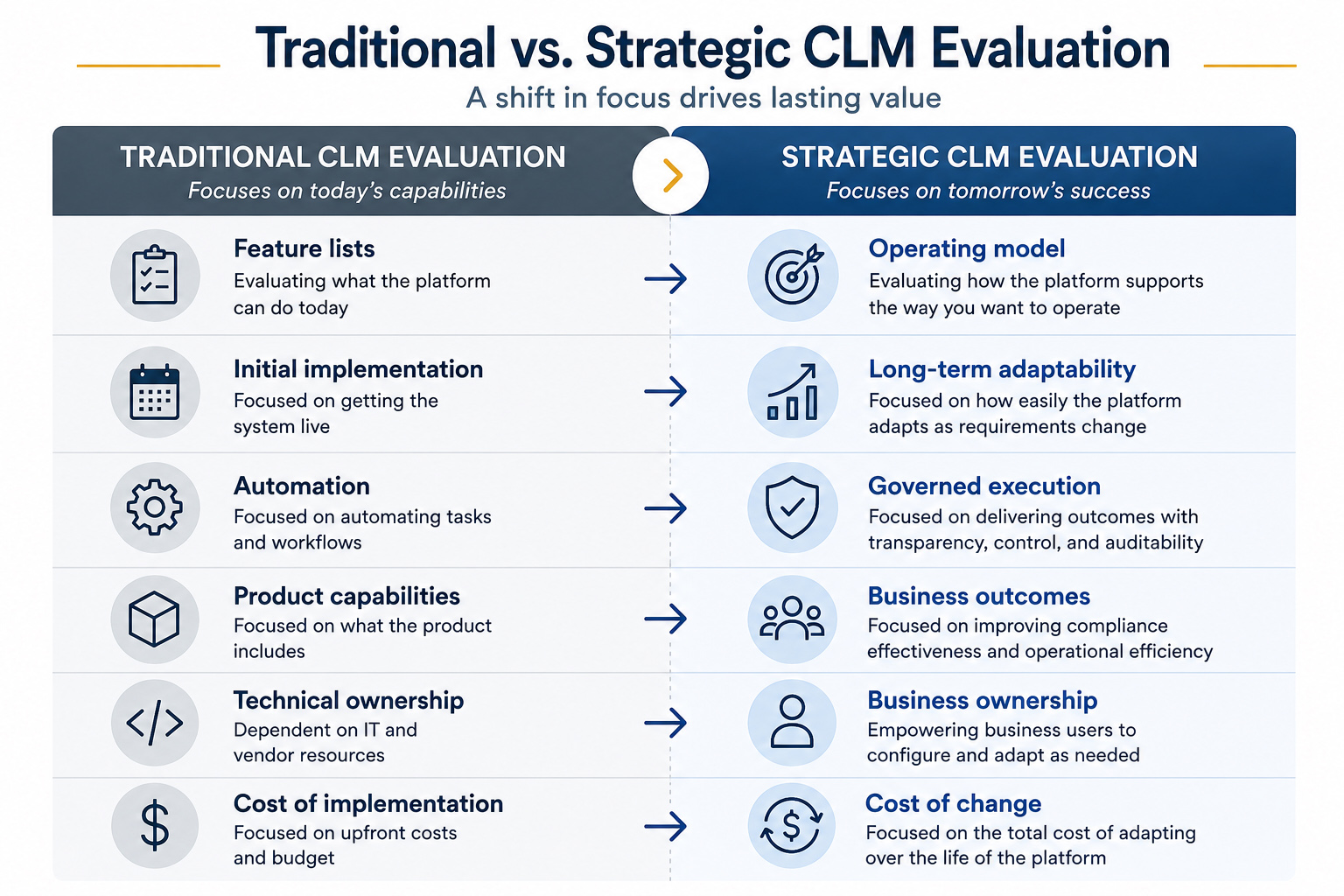
Evaluate your operating model—not just today’s feature list
Feature comparisons are useful, but they should not drive the evaluation. Two platforms may offer similar onboarding workflows, document management, or case routing while differing significantly in how they support long-term operational change. Financial institutions should begin by considering how they want compliance work to operate across business lines, jurisdictions, and regulatory environments before comparing individual product capabilities.
The most successful CLM implementations typically reflect a well-defined operating model rather than a collection of software features. Institutions should ask whether the platform supports their preferred approach to governance, approvals, collaboration, and business ownership—not simply whether it checks every box in a product demonstration.
Evaluate adaptability for the next regulatory change—not the last one
Perhaps the most important question is not what a platform can do today, but how easily it can change tomorrow.
Financial institutions continuously adjust policies, risk appetites, products, customer segments, and regulatory processes. A modern CLM platform should enable those operational changes without requiring extensive redevelopment or lengthy technology projects every time requirements evolve. The ability to configure workflows, business rules, approvals, and decision logic efficiently can significantly reduce both operational disruption and long-term costs.
When evaluating vendors, ask practical questions about change management. Which modifications can business users make through governed configuration? Which changes require custom development? How are updates tested, approved, documented, and deployed? These conversations often reveal more about the platform’s long-term value than even the most polished product demonstration.
Governance should be built into every workflow
Automation without governance is increasingly difficult to defend in a regulated environment. Financial institutions need confidence that operational decisions can be explained, approvals can be traced, and changes can be audited long after they occur.
Governance should extend beyond regulatory reporting to the day-to-day operation of the platform itself. Institutions should understand how workflow changes are controlled, how business rules are versioned, how exceptions are documented, and how audit trails are maintained. These capabilities become even more important as artificial intelligence is incorporated into customer due diligence and financial crime operations.
Rather than asking whether a platform includes AI, institutions should ask how AI is governed within operational workflows and how its recommendations remain transparent, reviewable, and accountable.
Consider the total cost of change—not just implementation
Technology evaluations often focus heavily on implementation cost, project duration, and licensing. While those factors deserve attention, they represent only part of the platform’s long-term value.
Compliance operations rarely remain static after implementation. New regulations, acquisitions, product launches, policy updates, and organizational changes all require the platform to evolve. Institutions should therefore consider the ongoing cost of adapting the system—not simply the cost of deploying it. A platform that is inexpensive to implement but expensive to modify may ultimately prove less valuable than one designed for continuous operational change.
This perspective shifts the conversation from total cost of ownership to something equally important: the total cost of change.
Evaluate business ownership and workflow orchestration
Compliance teams should not have to rely exclusively on software developers or external consultants every time an operational process changes. Modern CLM platforms increasingly enable business users to manage workflows, approvals, decision rules, and operational processes through governed configuration, allowing institutions to respond more quickly while maintaining appropriate oversight.
Workflow orchestration is equally important. Customer lifecycle management extends far beyond onboarding, encompassing periodic reviews, enhanced due diligence, remediation activities, escalations, approvals, and ongoing monitoring. Institutions should evaluate how effectively a platform coordinates work across departments while maintaining consistency, visibility, and accountability throughout the customer lifecycle.
Look beyond integrations to operational connectivity
Every CLM platform exists within a broader technology ecosystem. It must exchange information with sanctions screening, transaction monitoring, customer master data, document management, case management, identity verification, CRM, and core banking systems.
Strong integration capabilities certainly matter, but institutions should look beyond technical connectivity alone. The more important question is whether information, decisions, and workflows move seamlessly across operational processes. Effective integration should reduce duplication, improve consistency, and provide greater visibility across financial crime operations rather than simply connecting systems through APIs.
Questions every financial institution should ask CLM vendors
Product demonstrations rarely answer the questions that matter most over the life of a platform. As evaluations progress, institutions should look beyond functionality and explore how the platform will support ongoing operational change.
Consider asking questions such as:
- How are workflow and policy changes managed over time?
- Which changes can business users configure without software development?
- How does the platform support multiple jurisdictions and regulatory frameworks?
- How are governance, audit trails, and version control maintained?
- How are AI capabilities governed, monitored, and explained?
- What typically requires custom development?
- How does the platform reduce the long-term cost of operational change?
The quality of these conversations often provides a clearer picture of long-term success than a scripted product demonstration.
Choosing the right operating platform for the future
The best CLM platform is rarely the one with the longest feature list. It is the one that best supports the way a financial institution wants to operate—not only today, but as regulations, risks, technologies, and customer expectations continue to evolve.
Financial institutions should evaluate platforms through the lens of governance, operational adaptability, business ownership, workflow orchestration, and long-term change rather than current functionality alone. Organizations that adopt this broader perspective are often better positioned to respond confidently to future regulatory requirements while maintaining efficient, transparent, and governed compliance operations.
In our next article, we’ll apply these evaluation principles to consider the importance of architecture in leading Client Lifecycle Management platforms used by financial institutions today.
Frequently asked questions: Client Lifecycle Management software
Client Lifecycle Management (CLM) software helps financial institutions manage the complete customer lifecycle—from the first interaction with a prospective customer through onboarding, Know Your Customer (KYC) verification, customer due diligence (CDD), credit and risk assessments, ongoing account maintenance, periodic reviews, remediation, and customer offboarding. Modern CLM platforms also orchestrate workflows, approvals, and compliance activities across multiple business functions.
Customer Relationship Management (CRM) systems focus primarily on managing sales activities, customer interactions, and relationship development. Client Lifecycle Management (CLM) platforms manage the operational, risk, and regulatory processes that govern the customer relationship throughout its lifecycle. In financial institutions, CLM often integrates with CRM while extending into onboarding, KYC, due diligence, credit risk, compliance, and ongoing lifecycle management.
No. Know Your Customer (KYC) is one important component of Client Lifecycle Management. While KYC focuses on verifying customer identity and assessing risk during onboarding and periodic reviews, CLM manages the broader operational processes that span the entire customer relationship, including customer acquisition, onboarding, due diligence, ongoing maintenance, remediation, and offboarding.
Beyond core functionality, institutions should evaluate governance, operational adaptability, workflow orchestration, business ownership, multi-jurisdiction support, integration capabilities, auditability, and the platform’s ability to accommodate regulatory and policy changes over time. The most successful CLM platforms enable institutions to evolve efficiently while maintaining strong governance and operational consistency.
Financial institutions operate in an environment of continuous change. Regulations evolve, products expand, risk appetites shift, and customer expectations change. A platform that can be configured quickly through governed processes allows institutions to respond more efficiently while reducing the long-term cost of maintaining and adapting compliance operations.
Yes. Leading CLM platforms are designed to support different regulatory frameworks, documentation requirements, approval processes, and workflows across countries, business units, and product lines. The degree of flexibility varies significantly among platforms, making multi-jurisdiction support an important evaluation criterion for global financial institutions.
Rather than simply asking whether a platform includes AI, institutions should evaluate how AI is governed. Important considerations include transparency, explainability, human oversight, auditability, exception handling, and how AI-generated recommendations fit within established operational workflows. The goal is to ensure AI strengthens operational decision-making without compromising governance or regulatory accountability.