No-code compliance workflows promise flexibility. Very few actually deliver it in a way that changes how a Compliance program operates.
In many systems, no-code refers to light configuration—renaming a field, adjusting a rule, or requesting a vendor to make a change on your behalf. Those changes may be useful, but they do not fundamentally shift control.
At AML Partners, no-code in RegTechONE (RTO) is not about small adjustments. It is about enabling institutions to define, operate, and evolve their Compliance program directly—without being constrained by static system design.
With RegTechONE, you are not configuring a largely static system. You are defining how your Compliance program actually works and how it executes your program.
From static systems to no-code Compliance workflows
Traditional Compliance platforms are built around fixed structures. Fields are predefined. Screens are rigid. Workflows are difficult to change. When requirements evolve—as they inevitably do—institutions are forced into slow, costly development cycles.
RegTechONE takes a different approach. It starts with the idea that workflows should reflect how Compliance actually functions inside your institution—and that those workflows will change over time.
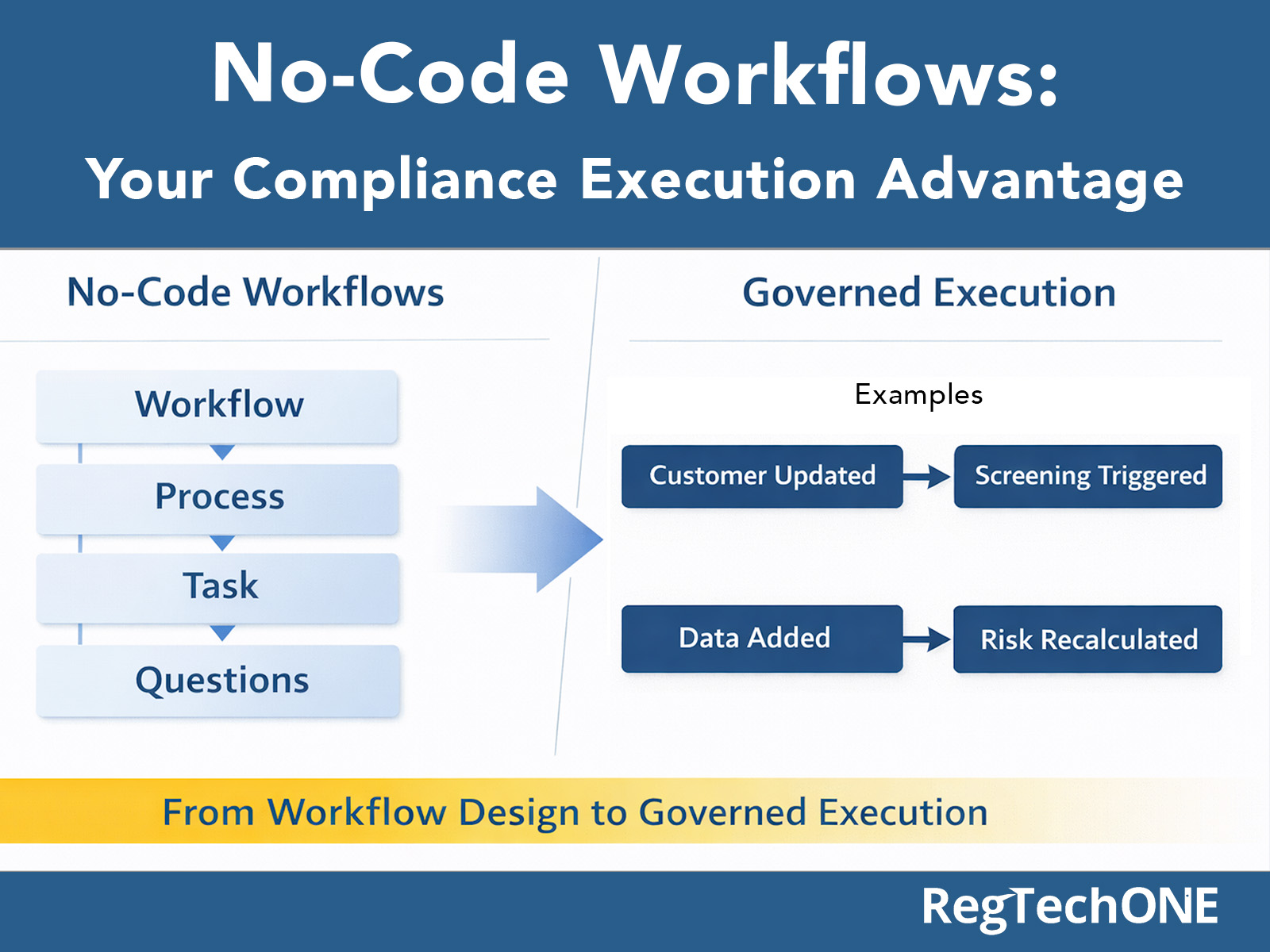
Every workflow in RegTechONE is built by your team, using a clear hierarchy that mirrors real operational flow:
- The workflow defines the end-to-end Compliance process
- Processes organize how that workflow moves across teams
- Tasks define the specific work that must be completed in each process
- Questions and inputs define exactly what data is collected for each task
There are no pre-set fields waiting to be filled. If your program requires a piece of information, you just configure its collection in your workflow—by placing a question or input exactly where it belongs and configuring it to meet your needs.
That means the “fields” in your system are not inherited from a vendor’s assumptions. They are defined by your institution’s actual risk, policy, and process.
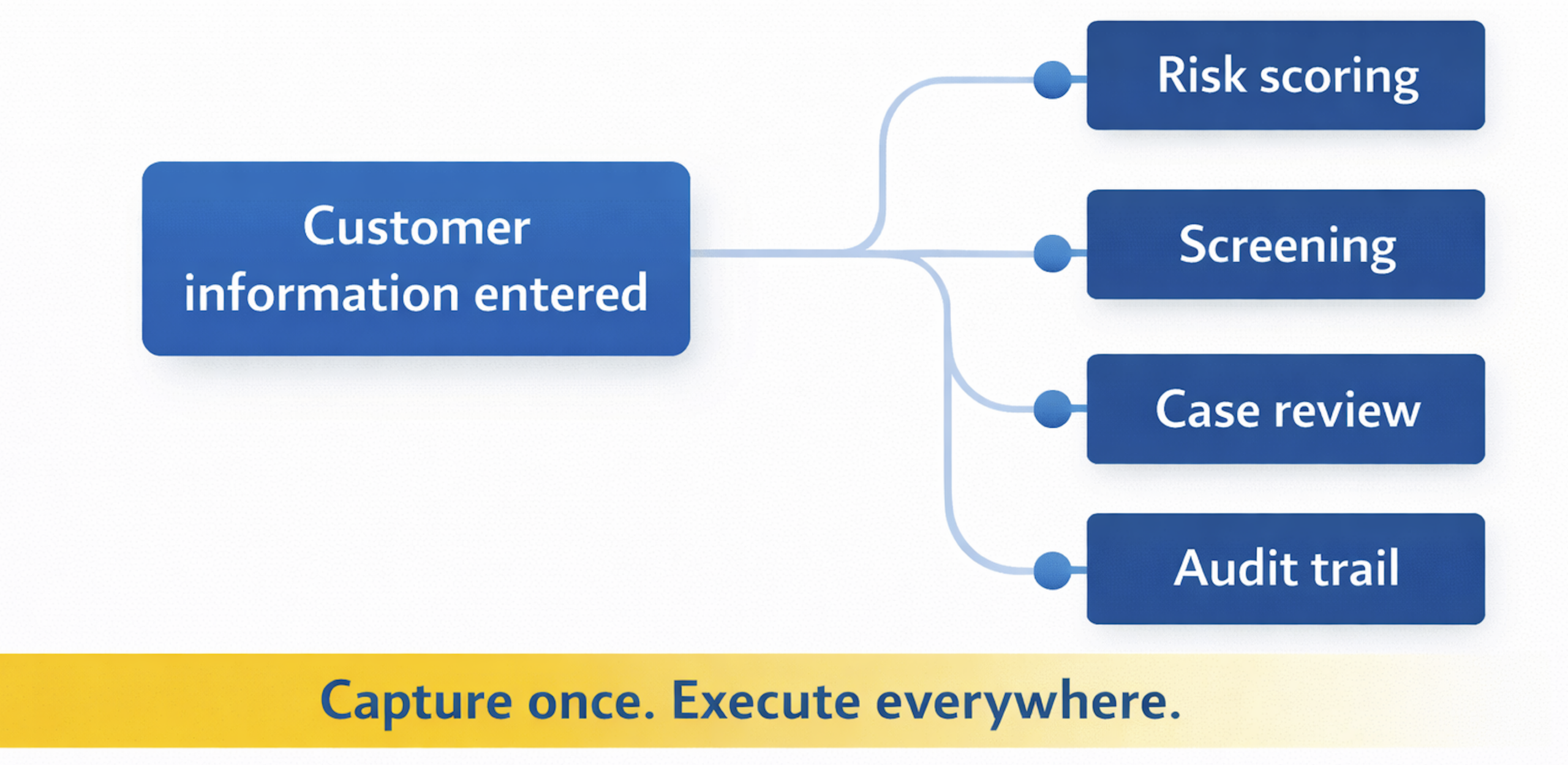
Capture once, use everywhere
One of the most immediate—and practical—impacts of no-code Compliance workflows is the elimination of duplication.
In many environments, the same information is entered repeatedly across different parts of the system. This creates inefficiency for investigators and introduces risk when data becomes inconsistent. RegTechONE removes that friction. A question or task is defined once, completed once, and then made available wherever it is needed across the workflow.
The result is not just a time savings, though that is significant. It is a structural improvement in data integrity and auditability:
- Information is consistent across processes
- Investigators are not re-entering the same data
- The full lifecycle of a data point is visible and traceable
It is a simple principle with far-reaching implications: Capture once, and let the system carry it forward.
Where no-code workflows become execution
Many platforms stop at workflow design. They might allow you to map a process, but not to reliably execute it.
RegTechONE connects no-code Compliance workflows directly to action. Once a workflow is defined, it can be extended into automated execution through event and action logic that is fully controlled by permissioned users. In practical terms, this means that when something happens in the system, your Compliance program can respond immediately and consistently.
For example, when a user creates or updates a customer record, that event can trigger actions such as the following:
- Screening names against relevant lists
- Recalculating customer risk based on new information
- Initiating additional review steps or workflows
These are not hard-coded behaviors embedded by a vendor. They are defined, refined, and governed by your team.
This is where no-code moves beyond flexibility and becomes something more meaningful: Your Compliance program—executed automatically, exactly as designed.
Control—and accountability—shift to the institution
The biggest value of no-code Compliance workflows is not speed, although speed matters. It is control.
In RegTechONE, permissioned users determine key elements like the following:
- What data is collected
- How workflows are structured
- What actions are triggered
- How the program evolves over time
This removes a persistent bottleneck in Compliance operations. You are no longer dependent on vendor timelines to adapt to new risks, regulatory expectations, or internal policy changes.
At the same time, this level of control introduces a new dynamic: responsibility.
The discipline behind the power
There is a tendency to assume that more flexibility automatically leads to better outcomes. In practice, the opposite can be true without the right operating discipline. When no-code Compliance workflows, triggers, and actions can be changed at any time, teams need to remember elements central to flexible systems:
- A small modification can have downstream effects
- Poorly structured logic can introduce unintended gaps
- Inconsistent changes can erode the integrity of the program
The institutions that succeed with true no-code RegTech solutions like RegTechONE are not simply those that embrace flexibility. They are the ones that pair flexibility with discipline—through clear governance, thoughtful design, and structured change control.
No-code does not eliminate complexity. It gives you direct control over it.
What no-code is—and what it is not
Clarity matters, especially with a term and concept–like no-code–that is often overstated.
In RegTechONE, no-code Compliance workflows enable institutions to define and manage the core elements of their Compliance program. These include the following: workflow design, task structure, data capture, and execution logic through events and actions.
It does not replace everything. System integrations, for example, are handled through data orchestration and do require code. Non-standard functionality may also require development.
That distinction is intentional. The goal is not to eliminate code entirely, but to ensure that the day-to-day operation and evolution of your Compliance program does not depend on coding.
A different model for Compliance workflows
Most Compliance platforms ask institutions to adapt to the system.
RegTechONE is built on the opposite premise: The system should adapt to the institution.
That shift—from static configuration to dynamic, no-code workflows tied directly to execution—changes what is possible. It allows Compliance programs to become more responsive to change, more consistent in execution, and more aligned with actual operational reality.
No-code, in this context, is not simply a feature. It is the foundation for a Compliance program that can evolve continuously without losing control.
Are you ready for no-code Compliance workflows?
The question is not whether no-code is powerful.
It is whether your organization is prepared to use that power deliberately. Because when implemented with discipline, no-code does more than improve efficiency. It turns Compliance from a designed program into an executed one.
FAQs about no-code Compliance workflows
No-code Compliance workflows allow institutions to design, manage, and execute Compliance processes without relying on code changes or vendor development cycles.
How are no-code workflows different from traditional AML systems?
Traditional systems rely on fixed fields and predefined workflows, while no-code workflows allow institutions to define data, processes, and execution logic dynamically.