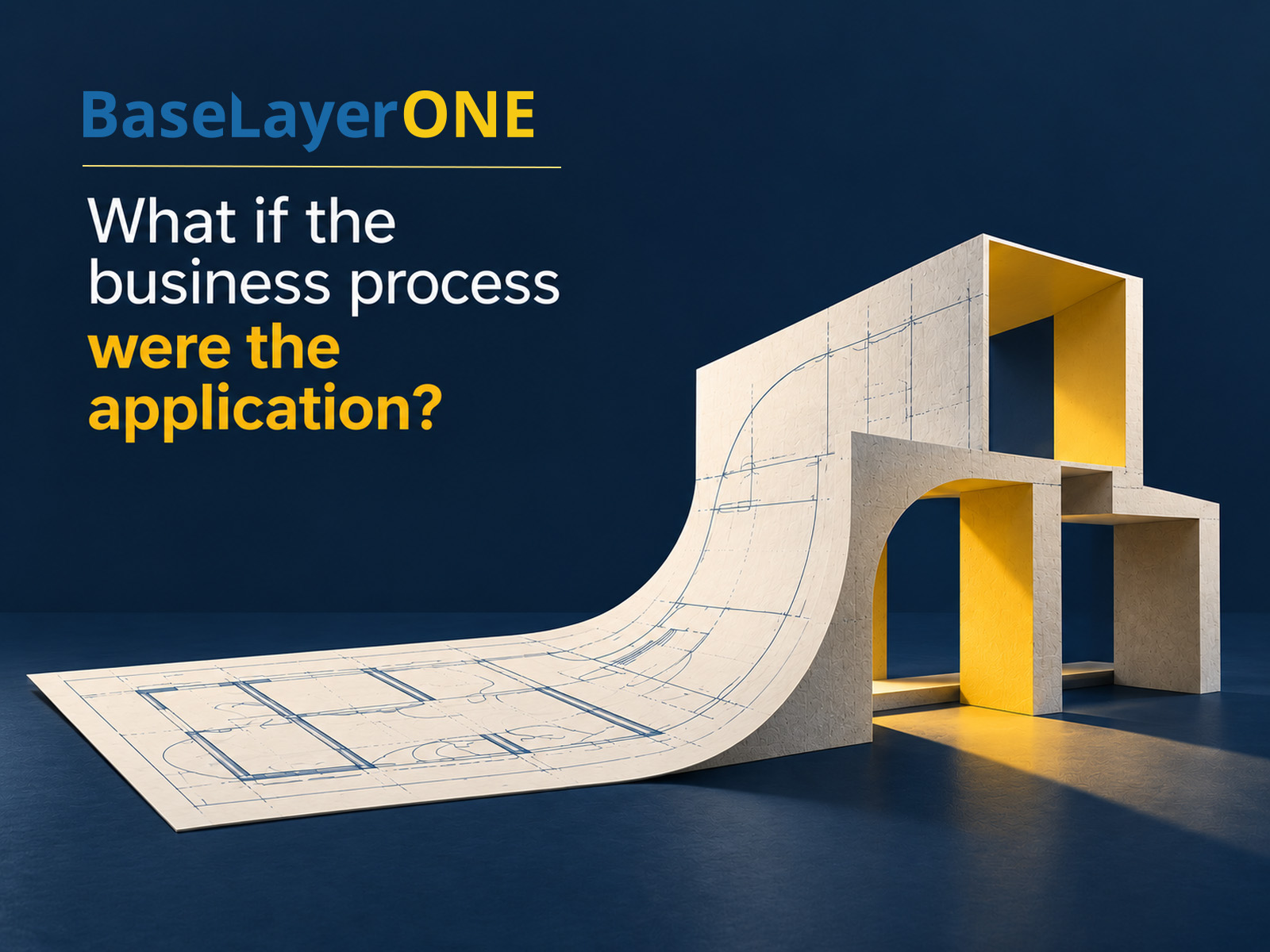
Enterprise software has traditionally separated the people who understand how work should happen from the technology used to make it happen. BaseLayerONE takes a different architectural approach.
Every organization runs on business processes. A customer is onboarded. A supplier is vetted. A claim is reviewed. A request is approved. An exception is escalated.
Those processes may look simple on a flowchart. In practice, each depends on information, decisions, rules, people, systems, permissions, deadlines, and actions working together. And when an organization wants software to support a new process—or change an existing one—the process itself is often the easy part.
Building the application is harder.
The business defines what it needs and then documents the requirements that become specifications. Developers translate those specifications into software. The application then undergoes tests, revisions, deployment, and eventually more changes when the underlying business process inevitably evolves.
That model has worked for decades. But it creates an enduring problem: The business process and the application that executes it exist as two different things.
What if they didn’t have to?
Key Idea:
Traditional application development translates a business process into software. BaseLayerONE takes a different approach: The configured process becomes the basis of the working application, while the platform provides the underlying application infrastructure.
From business process to working application
That question sits at the center of the architecture behind BaseLayerONE.
BaseLayerONE combines business process management and application-server capabilities within a single platform. Instead of modeling a process and then developing an application to implement that model, the process configured in BaseLayerONE becomes the basis of the running application.
The workflow defines how work moves. Dynamic information capture determines what the application needs to know at each point. Business and risk rules determine what should happen next. Human tasks and automated actions execute the work. Permissions control who can see and do what. The platform maintains the history and audit trail.
These aren’t separate components assembled into an application after the process has been designed. They operate as parts of the same underlying architecture.
That changes what it means to build business software.
The cost of translating business requirements into code
Traditional application development requires translation.
Someone who understands the business describes a requirement. A business analyst may formalize it. A technical team interprets it. Developers implement it. Users test whether the resulting application behaves as intended.
Each handoff introduces distance between the people who understand the process and the software that ultimately runs it.
The problem isn’t that developers don’t understand the requirements or that business users don’t understand technology. The problem is structural: Business logic has to be translated into another medium before the organization can execute it.
And the translation doesn’t happen only once.
When a regulation changes, a risk threshold moves, an approval path changes, or an organization discovers a better way to work, the cycle begins again. Over time, the application can become a constraint on the operating model it was originally designed to support.
BaseLayerONE takes a different approach. The platform handles the underlying application services while authorized users configure the business logic that makes one application different from another.
That makes configuration more than a convenience. It becomes part of the application architecture.
Software becomes a direct expression of the operating model
There is an important distinction here.
Eliminating code from the configuration of a business application doesn’t eliminate the engineering required to run enterprise software.
Applications still need data persistence. And authentication and permissions. And versioning, security, scalability, integration, auditability, and runtime services. Those capabilities have to come from somewhere.
BaseLayerONE provides them as shared platform services.
That means the people configuring an application don’t have to recreate those capabilities for every new business process. They work at a different layer: defining how information is captured, how work moves, how decisions are made, what gets automated, and where human judgment belongs.
The underlying platform takes responsibility for the common application infrastructure.
This is why it can be useful to think of BaseLayerONE less as a tool for creating individual workflows and more as a foundation for creating business applications.
The workflow matters. But it is only one part of the application.
A business application is more than a workflow
Consider supplier onboarding.
At its simplest, you might draw the process as a sequence: Collect supplier information, perform checks, assess risk, approve or escalate, and complete onboarding.
A working application has to do considerably more.
It needs to capture the right information and documents. It may need different information depending on the supplier or previous answers. It needs to validate that information. It needs to apply risk criteria consistently. Low-risk suppliers may follow one path while higher-risk suppliers require additional review. Tasks may need to move between people and systems. Deadlines and escalations may apply. Every decision may need to be recorded and defensible later.
In BaseLayerONE, those elements can be modeled together.
Dynamic forms capture the information required by the process. A risk engine evaluates that information against defined rules and thresholds. The workflow uses the resulting decisions to determine what happens next. Automated actions can perform routine system work, while designated tasks remain with people when judgment is required.
The result is a working application built around the actual business process rather than a business process adapted to the constraints of a predefined application.
And the same underlying platform components can be configured differently for a claims process, an internal approval, a customer journey, a risk assessment, or another operational need.
Configuration doesn’t have to mean constraint
Technical audiences have good reason to be skeptical of claims about “no-code.”
Too often, no-code means ‘easy’–until you reach the edge of what the product anticipated. Then the abstraction that made the simple case easy makes the difficult case impossible.
A platform intended to support varied business applications needs another characteristic: extensibility.
BaseLayerONE uses a plug-in architecture that allows developers to extend the building blocks available to application builders. Developers can create new question types, automated actions, machine learning agents, and other capabilities that become available within the platform’s configurable environment.
That creates an important division of labor.
Business experts don’t need to become software developers to express every change in a business process. And developers don’t disappear from the model. They can concentrate on engineering reusable capabilities and extensions rather than repeatedly rebuilding the application infrastructure surrounding each business requirement.
Configuration and extensibility aren’t competing ideas. A well-designed platform needs both.
When the process changes, change the process
Perhaps the most important consequence of this architecture appears after an application goes live.
Business processes don’t stay still. Policies change. Regulations change. Organizations reorganize. New information becomes available. Risk tolerances shift. Teams automate work that once required people.
A process that made sense two years ago may no longer represent how the organization wants to operate today. If the application’s behavior is deeply embedded in custom code, every significant operational change can become a software change.
In contrast, if the business logic is expressed through governed configuration, a different model becomes possible. Authorized users can modify the workflow, information requirements, rules, routing, or automation while the platform continues to provide the common application foundation underneath them.
The organization isn’t rebuilding its technology every time it changes how it operates. It is evolving the application along with the business.
A different relationship between business and software
This is ultimately the larger idea behind BaseLayerONE.
For years, enterprise software has asked organizations to translate the way they operate into applications—or, too often, adapt the way they operate to the applications they have.
A configurable application platform creates another possibility: Software can become a more direct expression of the organization’s operating model.
The processes will be different from organization to organization. And the applications built around them will be different too. But the foundation underneath them doesn’t have to be.
BaseLayerONE provides that shared foundation: a place to turn business processes into secure, governed applications—and keep changing them as the business changes.
Next in the BaseLayerONE series: Why Configurable Applications Need More Than a Workflow Engine — how workflows, dynamic information capture, and decision engines work together to turn a process model into a business application.
Frequently Asked Questions: BaseLayerONE business application platform
BaseLayerONE is a configurable application platform for building business applications around business processes. It combines workflow, dynamic information capture, business and risk rules, automation, human tasks, permissions, auditability, and shared application services within a common platform.
A workflow engine primarily determines how work moves through a process. A business application also needs to capture and validate information, apply rules and decisions, manage permissions, automate actions, support human judgment, integrate with other systems, and maintain a history of what happened. BaseLayerONE brings those capabilities together as parts of the same application architecture.
Business logic can be expressed through governed configuration rather than custom application code. Developers still play an important role when organizations need new integrations, specialized components, machine learning agents, automated actions, or other capabilities that require software engineering. BaseLayerONE’s plug-in architecture allows those capabilities to become reusable building blocks within the configurable platform.
Yes. Authorized users can modify configured workflows, information requirements, rules, routing, and automation as business requirements change, while BaseLayerONE continues to provide the shared application foundation underneath them.
The same underlying platform components can be configured around different operational needs, such as supplier onboarding, claims processes, internal approvals, customer journeys, and risk assessments. The business logic and process may differ while the application foundation remains shared.