CLM in banking: The challenge of coordination of relationships, AML, credit and legal reviews, and much more
Client Lifecycle Management (CLM) begins before a financial institution opens an account—and continues through every change in the relationship, every risk assessment, every compliance review, and ultimately, the decision to close the account.
For banks and other financial institutions, managing that lifecycle requires far more than efficient onboarding. CLM involves coordinating relationship management, KYC and due diligence, account administration, credit and legal reviews, transaction monitoring, sanctions screening, and ongoing risk management.
The challenge is not simply completing these activities. It is connecting them so that information, decisions, and changing risks move through the institution without losing context or control.
What is Client Lifecycle Management (CLM) in banking?
Client Lifecycle Management (CLM) is the process of managing a financial institution’s relationship with a customer from initial prospect identification through onboarding, account management, ongoing monitoring, and eventual offboarding.
In banking, CLM encompasses the commercial, operational, compliance, and risk management activities required to establish, maintain, and conclude a customer relationship. Although CLM is frequently associated with Know Your Customer (KYC) requirements, its scope extends well beyond customer identification and due diligence.
A complete CLM process must support multiple departments, including relationship management, operations, compliance, credit, legal, and risk management. Each contributes information, decisions, and approvals that affect the customer relationship.
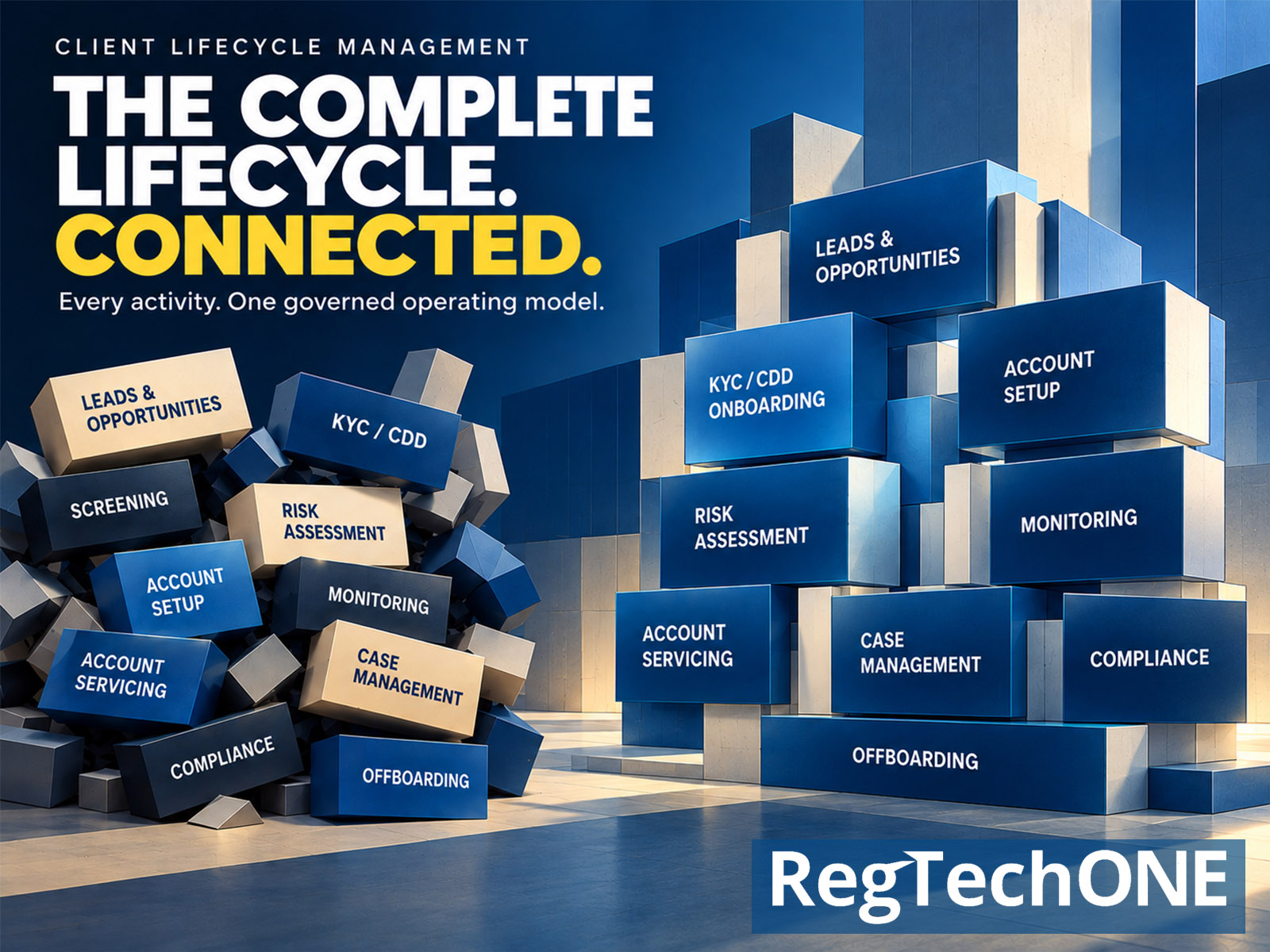
The objective is to manage these activities as parts of a connected lifecycle rather than as isolated departmental processes.
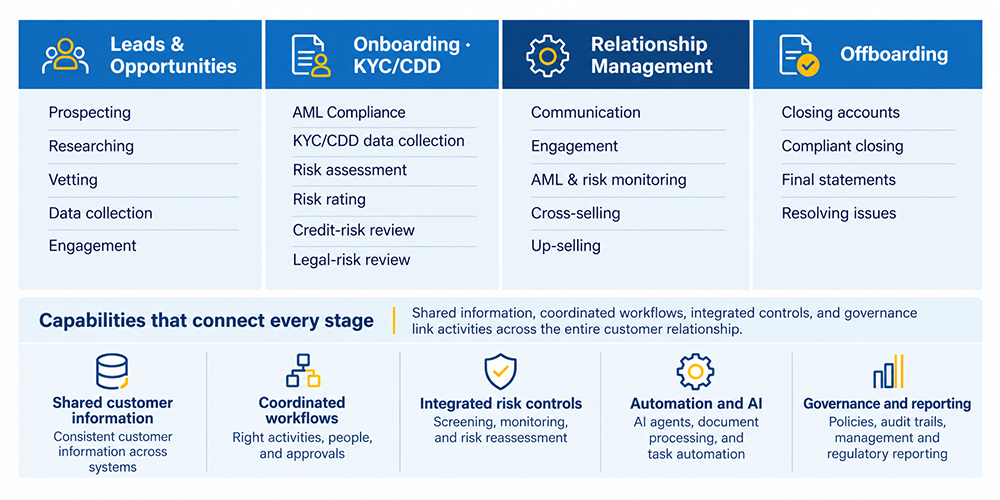
The key activities across the Client Lifecycle Management process
Financial institutions typically manage the customer relationship through four broad stages: prospecting, onboarding and account establishment, ongoing relationship management, and eventual offboarding.
Within those stages, institutions coordinate a wide range of commercial, operational, Compliance, and risk management activities. Some occur at particular points in the relationship; others—including customer servicing, risk assessments, monitoring, and periodic reviews—continue or recur as customer circumstances and risks change. The following seven areas illustrate the scope of that work.
Leads and opportunities: Evaluating prospective customers
CLM begins before formal onboarding, when institutions identify prospective customers, assess business opportunities, and determine whether potential relationships align with their commercial objectives and risk appetite.
Activities may include the following:
- Prospect identification and research: Gathering information about prospective customers, their businesses, and financial needs.
- Preliminary risk assessment: Identifying concerns like customer type, geography, industry, ownership, or anticipated activity–and any others required by the Compliance program.
- Relationship development: Managing initial communications, proposals, and business opportunities.
- Internal coordination: Sharing information among relationship managers, business development teams, and other stakeholders.
Information gathered during prospecting can provide valuable context for onboarding and subsequent risk assessments. A connected CLM process carries that information forward rather than requiring employees to collect or reconstruct it repeatedly.
Client onboarding: Establishing identity and assessing risk
Onboarding is among the most complex and compliance-intensive phases of the customer lifecycle. Financial institutions must establish customer identity, understand the proposed relationship, evaluate relevant risks, and obtain the approvals required to proceed.
Depending on the customer and applicable requirements, activities may include the following:
- Customer identification and verification: Collecting and validating identity information and supporting documentation.
- KYC/CDD: Establishing customer profiles, including business activities, ownership structures, anticipated account activity, and relevant customer risk factors.
- Enhanced Due Diligence (EDD): Conducting additional investigation when higher-risk circumstances warrant it.
- Sanctions and watchlist screening: Screening customers and relevant associated parties against applicable sanctions and other risk lists.
- PEP and adverse media screening: Identifying relationships and information that may warrant additional risk assessment.
- Credit and legal reviews: Coordinating assessments and approvals required by institutional processes.
- Documentation and approvals: Managing forms, supporting evidence, exceptions, and authorization decisions.
These activities frequently involve several departments, multiple data sources, and different approval authorities.
When institutions manage them through disconnected systems, onboarding becomes a series of handoffs, repeated requests, and manual reconciliations. A coordinated CLM process moves information and decisions through the required workflows while preserving the evidence supporting each determination.
Account setup: Activating the customer relationship
After completing the necessary onboarding requirements and approvals, the institution establishes the operational arrangements supporting the relationship.
Activities may include the following:
- Account creation: Establishing approved accounts, products, or services.
- Product and service configuration: Applying agreed terms, permissions, limits, and account parameters.
- Documentation management: Completing and retaining relevant agreements and records.
- System integration: Transferring approved information to authorized internal/external systems.
- Internal handoffs: Confirming that responsible teams have the information necessary to support the relationship.
In Client Lifecycle Management for banking, accurate information transfer matters. Customer identities, ownership details, risk ratings, restrictions, and approval conditions must remain consistent as the relationship moves from onboarding into active operations.
Ongoing relationship management: Maintaining an accurate customer profile
Customer relationships do not remain static. Ownership structures change. Businesses enter new markets. Customers request additional products. Risk characteristics evolve. Effective CLM must accommodate these changes while maintaining an accurate understanding of the customer.
Activities may include the following:
- Customer information updates: Maintaining current identity, contact, business, and ownership information.
- Periodic and Perpetual KYC reviews: Reassessing customer information and risk according to applicable requirements and institutional policies.
- Event-driven reviews: Initiating reassessments when material changes or risk indicators warrant attention.
- Relationship expansion: Evaluating requests for additional accounts, products, or services.
- Customer communications: Coordinating requests for information and documentation.
- Risk-rating updates: Adjusting assessments when new information changes the institution’s understanding of the relationship.
This phase illustrates why CLM cannot be reduced to onboarding. Institutions must continually maintain the information and decisions on which the relationship depends.
Account servicing and support: Managing everyday customer activity
Once a relationship is active, financial institutions must respond to customer needs while maintaining operational controls.
Activities may include the following:
- Customer service requests: Managing inquiries, account changes, and service-related issues.
- Transaction and account support: Coordinating operational activities associated with accounts and services.
- Documentation updates: Processing revised agreements, authorizations, and supporting records.
- Issue and exception management: Investigating problems and routing matters requiring additional review.
- Internal coordination: Connecting relationship managers, operations, compliance, and other stakeholders.
Servicing activities can generate information relevant to customer risk. Changes in risk-relevant customer information should trigger automated risk reassessments when warranted by the institution’s risk policies and applicable requirements. A request to change authorized signatories, introduce new products, or alter account arrangements may require additional verification, approvals, or due diligence. Connected CLM processes help ensure that servicing decisions reflect the customer’s current profile and applicable controls.
Compliance and risk management: Monitoring the relationship continuously
Compliance and risk management represent a distinct area of CLM responsibility, but their activities extend across the entire lifecycle. Financial institutions must identify, assess, monitor, and respond to risk from initial customer evaluation through account closure.
Depending on institutional obligations and risk-based policies, activities may include these types:
- Transaction and behavioral monitoring: Identifying activity that warrants review under applicable monitoring scenarios.
- Ongoing sanctions screening: Evaluating customers and associated parties against updated sanctions information.
- PEP and adverse media monitoring: Identifying developments that may affect customer risk.
- Customer risk reassessment: Reviewing risk ratings in response to changing circumstances.
- Alert investigation: Evaluating monitoring and screening results to determine whether additional action is necessary.
- Case management: Coordinating investigations, documentation, decisions, and approvals.
- Regulatory reporting: Preparing and submitting required reports, including suspicious activity reports when applicable.
- Audit and examination support: Maintaining records of activities, decisions, evidence, and control execution, including manual and automated systems (including AI).
These responsibilities require more than detecting potentially suspicious activity. Institutions must manage what happens next: Who investigates, what information they review, which decisions require approval, and how the outcome is documented.
Connecting monitoring, investigation, customer information, and operational workflows is central to effective lifecycle risk management.
Offboarding management: Closing the relationship with appropriate controls
Offboarding may result from a customer’s request, a business decision, changes in risk appetite, regulatory restrictions, or other circumstances.
Activities may include elements like these:
- Relationship closure assessment: Determining the reasons for closure and identifying applicable requirements.
- Internal approvals: Obtaining authorization from relevant business, compliance, legal, or risk functions.
- Account and service termination: Coordinating closure of affected accounts, products, and services.
- Customer communications: Managing required notifications and correspondence.
- Final compliance review: Addressing outstanding alerts, investigations, reporting obligations, or restrictions.
- Records retention: Preserving all information and documentation according to applicable obligations.
Offboarding is not simply the reverse of onboarding. It requires coordinated decisions, operational execution, and appropriate documentation through the final disposition of the relationship.
What connects Client Lifecycle Management activities across the customer relationship?
The activities described above illustrate the scope of Client Lifecycle Management. But identifying those activities is only the beginning. What makes CLM effective is how financial institutions connect the work, information, decisions, and controls across the customer relationship.
The challenge is maintaining those connections as customers move through different stages of the relationship—and as servicing, monitoring, reviews, and risk assessments continue or recur.
Information gathered during prospecting should inform onboarding. Risk assessments completed during onboarding should remain available during servicing. Monitoring results should inform investigations and, when appropriate, customer risk reassessments. Decisions to restrict or close relationships should reflect current information and applicable policies. These connections depend on five capabilities:
Consistent customer information. Relevant departments need access to accurate, current information about the customer and relationship.
Coordinated workflows. Activities involving multiple participants, reviews, or approvals must move through defined processes.
Integrated risk controls. Screening, monitoring, due diligence, and risk assessments must support decisions throughout the lifecycle.
Dynamic Case Management. Exceptions, investigations, and complex matters require coordinated work that may extend beyond routine processes.
Governance and auditability. Institutions must establish who performed an activity, what information supported a decision, and whether required controls were followed for both manual and automated processes (including AI).
Together, these capabilities make CLM a connected operating process rather than a sequence of departmental tasks.
Why fragmented CLM processes create operational and compliance risk
Many financial institutions have invested heavily in individual components of Client Lifecycle Management. They may have dedicated systems for customer relationship management, onboarding, sanctions screening, transaction monitoring, case management, and account servicing. Each system may perform its assigned function effectively. But problems emerge when work must move between them.
Customer information requires repeated entry or reconciliation. Changes in risk may not reach every relevant process promptly. Employees rely on emails, spreadsheets, or manual handoffs to coordinate approvals and investigations. These gaps increase operating costs, delay customer service, complicate regulatory reviews, and can weaken the institution’s ability to demonstrate consistent control execution.
Further, adding another specialized application does not necessarily resolve the underlying problem. Financial institutions need to coordinate the activities, information, decisions, and controls spanning the customer relationship.
How RegTechONE connects and governs Client Lifecycle Management
RegTechONE, the configurable RegTech platform from AML Partners, provides an integrated environment for managing Client Lifecycle Management and associated risk and compliance activities. Its approach differs from software that automates individual tasks but leaves institutions responsible for connecting the processes around them.
RegTechONE enables institutions to configure how work moves across the lifecycle—and govern how that work is performed.
Its capabilities include the following:
No-code workflow configuration including AI. Authorized users can design and modify workflows. Drag-and-drop for all tools, including AI.
Integrated compliance and risk tools. RegTechONE brings together KYC, customer risk assessment, sanctions and watchlist screening, behavioral monitoring, and other compliance capabilities within a configurable operating environment.
Dynamic Case Management. Institutions can coordinate investigations, exceptions, reviews, and decisions requiring information and participation from multiple functions. Cases can bring relevant information, activities, and decisions together rather than leaving employees to manage complex work through disconnected processes.
Embedded AI agents. RegTechONE supports AI-enabled activities within governed workflows. Institutions can incorporate capabilities such as summarization, document processing, and information extraction into defined operational processes, with appropriate controls over how those capabilities are used.
Governance across the lifecycle. Configured workflows, permissions, approvals, and audit records help institutions manage how work is performed and documented across functions.
Integration with existing systems. RegTechONE’s architecture supports connections with internal and external applications and data sources, allowing institutions to coordinate existing technologies within broader lifecycle processes.
These capabilities support a fundamental distinction.
Automating an onboarding review may make that particular activity faster. But managing the complete lifecycle requires the institution to determine what happens before and after that review, how decisions affect subsequent activities, and how changing information triggers additional work.
RegTechONE provides the configurable workflows, integrated capabilities, and governance framework to manage those connections.
Institutions can adapt their processes as business needs, regulatory requirements, and risk policies evolve—without treating every change as a new software development project.
The benefits of effective Client Lifecycle Management
When financial institutions manage CLM as a coordinated process, they can improve outcomes across several areas.
Better customer experiences
Coordinated workflows reduce repetitive information requests, unnecessary handoffs, and avoidable delays. Customers benefit when the institution maintains continuity across onboarding, servicing, reviews, and relationship changes.
Stronger AML Compliance and risk management
Connected information and processes help institutions apply risk-based controls more consistently. Compliance personnel can work with relevant customer information, monitoring results, investigation records, and prior decisions without reconstructing the relationship from disconnected sources.
Greater operational efficiency
Configurable workflows and automation reduce manual coordination, repetitive data entry, and administrative effort. Employees can devote more attention to activities requiring professional judgment, investigation, and customer engagement.
More adaptable business operations
Customer expectations, regulatory requirements, institutional policies, and business priorities change. A configurable CLM environment allows institutions to modify processes, introduce controls, and accommodate new requirements without repeatedly rebuilding their operating model.
Better management visibility
Coordinated lifecycle processes provide clearer visibility into workflow status, outstanding reviews, exceptions, approvals, and operational performance. That visibility supports day-to-day management and longer-term process improvement.
Originally published December 2024. Substantially updated October 2026.
Frequently asked questions about Client Lifecycle Management
Client Lifecycle Management (CLM) in banking is the coordinated management of a customer relationship from initial prospect evaluation through onboarding, account management, ongoing monitoring, and eventual offboarding. It encompasses commercial, operational, compliance, and risk management activities.
Client Lifecycle Management can be understood through four broad stages: prospecting, onboarding and account establishment, ongoing relationship management, and offboarding. Within these stages, financial institutions coordinate activities including KYC/CDD, account servicing, transaction monitoring, sanctions screening, risk assessments, investigations, and regulatory compliance. Many of these activities overlap or recur throughout the customer relationship.
Know Your Customer (KYC) focuses on identifying customers, understanding their activities and risk characteristics, and conducting required due diligence and ongoing reviews. Client Lifecycle Management encompasses KYC but also includes the broader commercial, operational, servicing, and relationship management processes involved throughout the customer lifecycle.
Customer circumstances and risks can change after onboarding. Ongoing monitoring helps financial institutions identify changes in activity, sanctions exposure, customer information, and other risk indicators that may require investigation, reassessment, or additional controls.
Financial institutions should evaluate whether CLM software supports the full scope of their lifecycle processes, integrates relevant risk and compliance capabilities, accommodates existing systems, provides configurable workflows, supports complex investigations, and maintains appropriate governance and auditability.
Manage the complete client lifecycle with RegTechONE
Effective Client Lifecycle Management requires financial institutions to manage far more than customer onboarding. It requires connecting the information, people, decisions, and controls involved throughout the relationship—and maintaining those connections as circumstances change.
RegTechONE supports that approach through configurable workflows, integrated compliance capabilities, Dynamic Case Management, and governed AI-enabled operations. AML Partners offers a free proof of concept that allows financial institutions to explore how RegTechONE can support their own requirements using representative workflows and business scenarios.
Explore RegTechONE Client Lifecycle Management capabilities and see how your institution can manage the complete lifecycle through connected, configurable processes.
Read more about Client Lifecycle Management in Banking:
How to evaluate Client Lifecycle Management (CLM) Software
Learn the evaluation criteria modern financial institutions should use when selecting a CLM platform.
What makes the best Client Lifecycle Management software?
Discover why architecture, adaptability, and governed execution matter more than feature count.
A different approach to Client Lifecycle Management
RegTechONE helps financial institutions continuously improve their CLM processes. Learn how a governed operational platform supports changing regulations, evolving risks, AI-enabled operations, and new business requirements without rebuilding the underlying technology.
Explore related topics
What governed execution in AML Compliance actually means
Learn why governance and operational agility are no longer competing priorities—and why governed execution is becoming the foundation of modern compliance.
Why No-Code Compliance is more powerful than you think
Discover how governed no-code configuration allows compliance teams to adapt faster while maintaining control, transparency, and auditability.
Agents at the workflow layer: Why governed execution matters in AML workflow agents
Understand how governed no-code configuration reduces the cost of operational change without sacrificing control.
Your next competitive advantage? Continuous adaptation
See why the ability to evolve compliance operations quickly may become the defining competitive advantage for tomorrow’s financial institutions.