The AI making headlines is not the AI you want running your AML Compliance operations.
Much of the excitement around AI centers on systems that can reason independently, explore information, select tools, and take increasingly autonomous action. Impressive capabilities, certainly. But in a production Compliance environment, how much freedom should an AI agent actually have?
For financial institutions, the answer may be considerably less than the AI industry would have us believe.
Some of the most valuable applications of AI in AML Compliance involve specific, well-defined tasks: Extracting information from documents, identifying beneficial owners, summarizing investigations, preparing information for screening, and assembling reports for analysts.
These tasks don’t require agents to roam across external systems, invent new workflows, or independently decide what to do next. They require intelligence applied to operational work, within boundaries the institution itself controls.
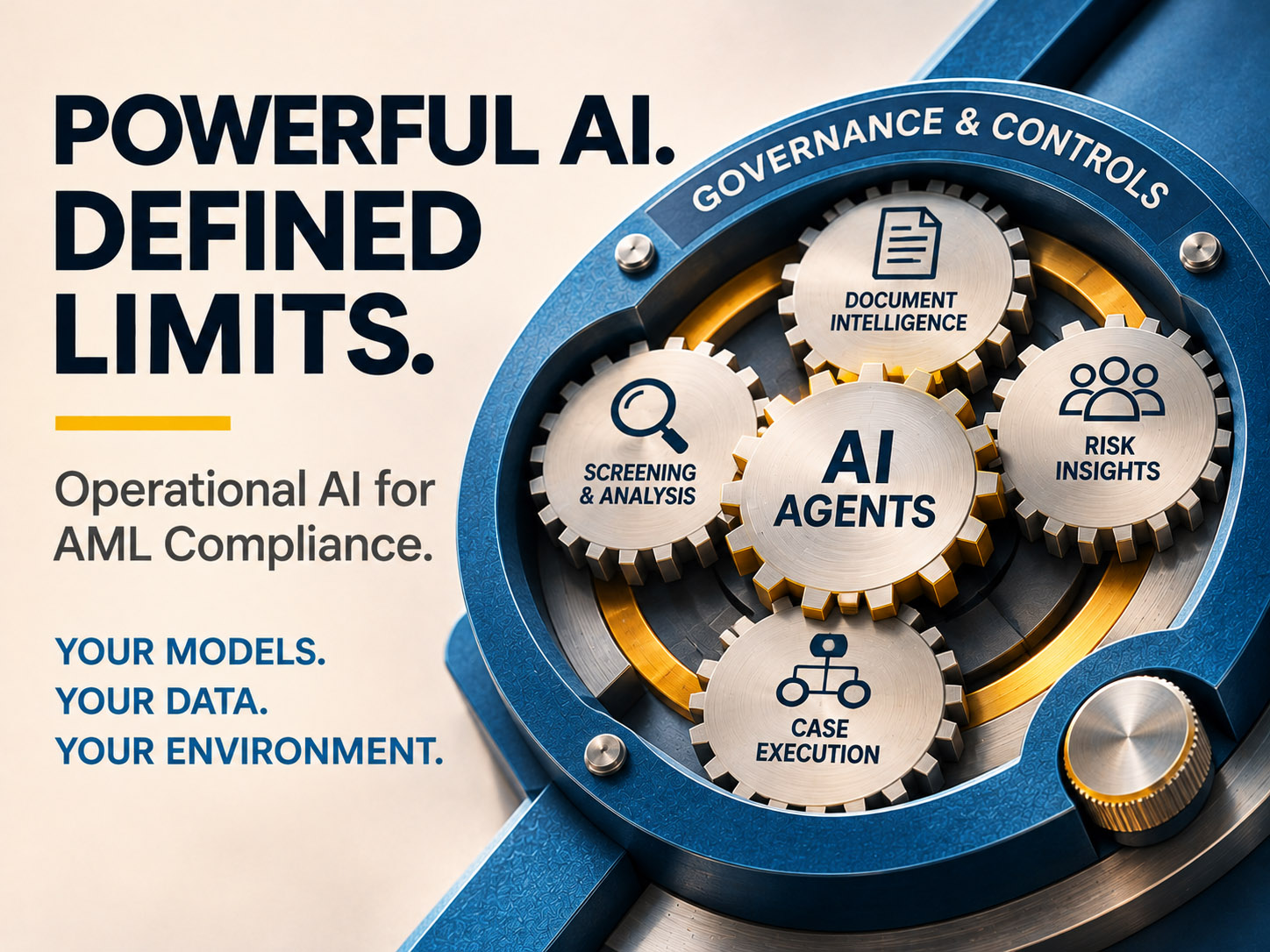
That’s the promise of Operational AI (OpAI): putting AI to work without giving up control of the work. Operational AI (OpAI) uses purpose-built AI agents to perform defined tasks within governed business workflows. In AML Compliance, these agents can work with locally hosted models, allowing financial institutions to control data processing, agent permissions, model updates, and operational oversight.
More autonomous AI isn’t necessarily better AI for AML Compliance
The race to build more capable AI agents has created an assumption that greater autonomy always signifies progress.
An agent that can independently select tools, retrieve information, formulate plans, and execute multiple steps may be useful in some settings. But those capabilities can introduce unnecessary risk when the work involves sensitive customer information, regulatory obligations, and decisions that must withstand scrutiny.
An AML analyst doesn’t need an AI agent that can do anything. The analyst needs an agent that can do a particular job accurately, consistently, and within established procedures.
Consider a beneficial ownership review. The work may involve reading a corporate document, identifying relevant entities and ownership percentages, and preparing that information for screening or further review.
The agent doesn’t need broad internet access or authority to redesign the onboarding process. It needs access to the appropriate documents, a defined assignment, and a controlled path for delivering its results.
The point isn’t to make AI less capable. It’s to apply its best AML capabilities where they belong.
Your customer data doesn’t have to travel to an external AI service
Where an AI model runs matters tremendously.
Many organizations encounter generative AI through cloud-hosted services. An application sends a request to an external model provider, receives a response, and incorporates that response into a business process.
That architecture may be appropriate for many purposes. But financial institutions need to examine it carefully before sending customer records, beneficial ownership information, transaction details, or investigation materials outside their controlled environments.
Who receives the data? Where is it processed? What information is retained? Which third parties participate? Who controls access and use? These are fundamental Compliance and operational-risk questions.
AI models can also run locally, within infrastructure controlled by the institution. Instead of sending sensitive information to an external model provider, the institution can process it within its own environment.
RegTechONE supports locally deployed AI models that work with specialized agents inside established AML Compliance workflows. Institutions control the models they deploy, and they control when those models are updated or replaced.
A locally hosted deployment isn’t usually a physically air-gapped system. Institutions may still use authorized network connections and integrations. But AI processing need not depend on an outside model provider, and sensitive information can remain within the institution’s governed environment.
For organizations with stringent confidentiality, data protection, or operational requirements, that distinction matters.
Give agents a job description, not an open-ended assignment
Where AI runs is only part of the story. What AI can do matters just as much.
Operational AI takes a deliberately focused approach. Each agent performs an assigned task using approved resources and delivers its output into a defined workflow.
One agent may summarize a lengthy document. Another may identify names, entities, and ownership percentages. Another may assemble information into a report for analyst review.
These activities consume substantial analyst time, and AI can handle much of the information processing far more efficiently. None requires unrestricted autonomy.
Within RegTechONE, institutions can define and control agent instructions, restrict access to authorized data and tools, and determine how outputs move through subsequent workflow steps. Agents operate within the platform’s configurable Compliance processes, including its permissions, rules, and case management capabilities.
The institution establishes the work, the boundaries, and the oversight. The agent executes its assignment.
Fixed models give institutions control over change
An important feature of Operational AI is that its underlying models don’t need to learn or retrain themselves as they perform production tasks.
A locally deployed model can operate with fixed weights and a controlled configuration. Institutions can determine which model version is in use, when to introduce an update, and how to validate changes before deployment.
That matters in AML Compliance, where institutions must manage technology changes without compromising the integrity of their processes.
RegTechONE supports institution-controlled model versions, predefined agent instructions, and governed changes to agent operation. Rather than allowing an agent’s underlying model to evolve independently, institutions can evaluate and approve changes through their established controls. This keeps institutions’ AI within workflows that provide validation, exception handling, and human review where appropriate.
AI activity belongs in the audit trail
AML Compliance operations depend on evidence. Institutions need to demonstrate that required activities occurred, reconstruct how information moved through a process, and document the decisions that followed.
AI agents should meet the same expectations.
When an agent extracts information from a document or prepares an investigation summary, the institution should be able to determine what information it received, which model and instructions were used, what output it produced, and what happened next.
RegTechONE records agent execution and outputs within its governed workflows. Institutions can review the results, trace subsequent actions, and document how analysts handled the information. An audit trail shows what the system did and how its outputs were handled; it doesn’t automatically establish that every conclusion was correct.
That distinction matters. Financial institutions need AI they can supervise, test, and hold accountable as part of their production Compliance operations.
The real payoff is less analyst drudgery, not more AI independence
Financial institutions don’t need AI agents to become independent Compliance officers. They need help with the enormous volume of work surrounding Compliance decisions.
Consider an analyst reviewing a complex customer file. Documents may contain dozens of names, multiple ownership layers, varying percentages, and information scattered across different formats.
The biggest value of an analyst’s expertise lies in evaluating risk, investigating inconsistencies, interpreting findings, and making appropriate judgments. But should that analyst spend hours locating names, copying ownership percentages, preparing screening inputs, and assembling information into a usable format?
Operational AI can take on much of that preparatory work. It can extract and organize relevant information, prepare reports, and deliver results directly into the workflows analysts already use.
The analyst retains responsibility for reviewing the information and exercising judgment. The technology handles repetitive processing.
Institutions gain efficiency while preserving their established Compliance controls. They can introduce useful AI capabilities without creating a separate, loosely governed operation alongside their existing systems.
The smartest AI strategy may be to limit what AI can do
The AI industry will continue pursuing more powerful models, greater connectivity, and increasingly autonomous agents. Those advances will create opportunities, but financial institutions should be selective about which capabilities belong in production AML Compliance.
The measure of a successful AI deployment isn’t how independently an agent can operate. It’s whether the agent performs useful work accurately, efficiently, and within the institution’s requirements for data protection, oversight, and accountability.
Locally deployed models keep AI processing under institutional control. Purpose-built agents limit access and authority to the work assigned. Governed workflows provide the operational record and oversight needed to manage AI in production.
Together, these capabilities make it possible to capture substantial benefits from AI without granting agents unnecessary freedom.
That’s the value of Operational AI. The objective isn’t to set AI loose. It’s to put AI to work.

See Operational AI work with your own Compliance requirements
RegTechONE® combines configurable AML Compliance workflows, specialized AI agents, and flexible deployment options in a single governed platform. Its no-code architecture allows institutions to incorporate AI into existing operating processes while retaining control over models, agent behavior, and the work they perform.
Request a free Proof of Concept to explore how RegTechONE can apply Operational AI to your institution’s requirements, workflows, and data governance needs.