Rolling with change is central to the work of AML Compliance. But even small changes can have big impacts. A seemingly manageable change can quickly become a substantial undertaking that affects risk-scoring rules, exceptions, reviews, escalation requirements, and more.
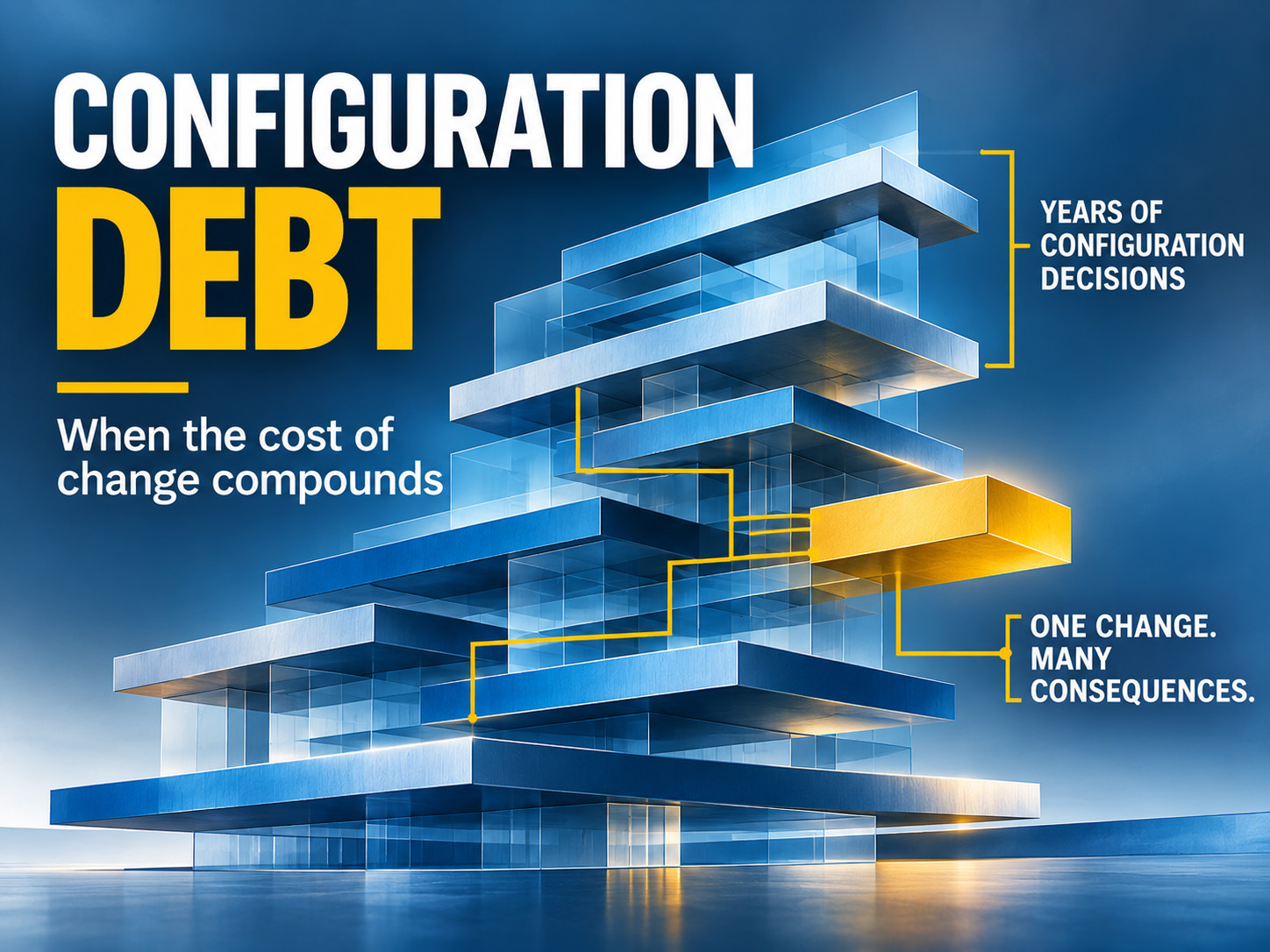
Some of that work is essential to effective Compliance. But some of the effort may stem from years of accumulated configuration decisions that have made the system increasingly difficult to understand and modify.
This is configuration debt. And it exposes a cost of AML technology that institutions may underestimate when they select and implement a platform: the cost of changing it over time.
Configuration debt accumulates through decisions that once made sense
Configuration debt is the accumulated burden in a system’s configured rules, workflows, parameters, exceptions, and dependencies that makes future changes progressively harder, slower, riskier, or more costly. (Configuration debt concerns the difficulty of changing a system’s configured behavior. Related operational debt can accumulate in the workarounds, manual interventions, and fragmented processes surrounding that system.)
The concept has roots in software engineering. Researchers there have examined how configuration complexity contributes to technical debt. In AML operations, it helps explain why systems that initially met an institution’s requirements can become increasingly difficult to adapt.
Consider a customer-risk assessment system that has been operating for a decade.
During that period, the institution has introduced new products, entered additional markets, revised its risk appetite, responded to regulatory developments, and refined its treatment of particular customer populations. Each change may have required adjustments to risk factors, scoring rules, thresholds, exceptions, or review requirements.
Many of those decisions were appropriate. Some remain essential. Others may have been superseded by subsequent changes, while their effects remain embedded in the configuration.
Over time, the institution can accumulate a web of interdependent settings whose combined behavior is harder to understand than any individual rule.
The distinction matters. Complexity is not automatically debt. AML operations are inherently complex, and a sophisticated risk methodology may require sophisticated configuration. The problem arises when accumulated configuration choices impose unnecessary burdens on future changes.
Configuration debt isn’t measured by how much has been configured. It’s revealed by what happens when you need to change it.
The true cost emerges when one change affects many others
Suppose Compliance determines that certain combinations of geographic exposure, customer activity, and ownership characteristics should receive greater weight in its customer-risk methodology.
Changing the relevant scoring parameters may be straightforward in isolation. But the institution must also determine how those parameters interact with existing rules and what consequences the revised scores will have elsewhere.
Will customers move into different risk categories? Will some become subject to enhanced due diligence? Will review frequencies change? Will approval requirements or escalation paths be affected? Are there exceptions that override the standard methodology for particular business lines or customer types?
These are important and predictable questions that accompany changes to a risk methodology. A well-governed institution naturally evaluates the consequences of material changes to its controls.
The problem with accumulated configuration debt is that it adds work to processes that are already crucial and complex. Teams may need to reconstruct why particular settings exist, identify dependencies that are not readily visible, determine whether old exceptions remain relevant, or investigate interactions that were never fully documented. They may discover that modifying one rule produces unexpected results elsewhere.
The institution must spend additional time understanding its existing configuration before it can confidently change it. A useful measure of configuration debt is the additional effort required to understand and modify existing rules and dependencies beyond the work necessary to assess, approve, test, and document the change.
This is where the debt analogy becomes useful. Accumulated configuration choices and dependencies represent the principal. The recurring extra effort required to understand, test, modify, and troubleshoot them resembles interest. That interest is paid whenever the institution needs to make another change.
A platform that appears economical to implement can become expensive to maintain if significant modifications repeatedly require extensive investigation and rework.
Configuration debt can make Compliance less responsive to change
The consequences of configuration debt extend beyond development hours and implementation budgets.
Consider what happens when a Compliance team identifies an improvement to its risk methodology but learns that implementing it will require months of analysis, testing, and coordination.
The institution may still proceed. But the difficulty of implementation can influence its decisions. A team may postpone an improvement until a larger technology release, narrow the scope of a change to avoid disturbing existing dependencies, or preserve an outdated exception because removing it requires extensive investigation.
There can be sound reasons for sequencing changes carefully. But accumulated configuration complexity can introduce constraints that have little to do with the underlying compliance objective.
This creates an important distinction between the institution’s ability to decide what its controls should do and its ability to make its technology do it.
The first depends on risk judgment, regulatory interpretation, policy, and governance. The second depends partly on the institution’s technology architecture and the condition of its accumulated configuration.
When the gap between those capabilities widens, technology can begin to constrain operational decisions rather than support them.
For a Chief Compliance Officer, that raises a question worth asking: How much does the difficulty of changing existing systems influence which compliance improvements the institution undertakes—and when?
Implementation cost tells only part of the technology investment story
Financial institutions devote substantial attention to the cost and complexity of implementing AML technology. They evaluate licensing, implementation services, integrations, migration requirements, staffing, training, and the time needed to bring a platform into production.
Those are essential considerations. But they largely describe the investment required to establish the operating environment. They reveal less about what it will cost to evolve that environment over the next five, ten, or fifteen years.
An institution might implement a capable platform that accommodates every requirement in its initial specification. Over time, however, changes to the business and its compliance obligations may expose limitations in how easily its configured operating logic can be understood and modified.
This makes the cost of change an important dimension of total cost of ownership.
That cost includes more than vendor fees or technical labor. It encompasses the time Compliance personnel spend explaining requirements, the effort needed to assess configuration dependencies, the resources devoted to regression testing, and the coordination required to validate and implement changes.
Some of these costs are unavoidable in a controlled environment. Others reflect the accumulated burden of earlier configuration decisions.
The challenge for buyers is that configuration debt can be difficult to assess during a conventional product demonstration. A vendor can show that a platform supports complex rules and workflows without demonstrating how manageable those configurations will remain as requirements evolve.
The more revealing question is not simply whether the platform can accommodate today’s complexity. It is whether the institution can continue to manage that complexity without progressively sacrificing its ability to change.
No-code can improve changeability without eliminating configuration debt
No-code technology offers a different approach to managing compliance operating logic.
Rather than requiring changes to underlying platform code for every adjustment, a governed no-code environment can allow authorized users to configure workflows, risk models, business rules, approval requirements, and other elements of the operating process.
In RegTechONE®, authorized users can configure and modify compliance workflows and risk logic within the platform’s governed operating environment. This gives institutions greater control over how their compliance processes operate and evolve and can reduce dependence on software-development projects for changes that belong within the configurable operating model.
But no-code technology does not eliminate configuration debt.
A poorly designed no-code implementation can accumulate unnecessary exceptions, duplicative rules, unclear dependencies, and configuration choices that become difficult to maintain. Giving users more configuration tools does not automatically produce a better operating model.
The advantage lies in supporting configuration that remains understandable, governable, and changeable over time.
Institutions still need appropriate access controls, testing, approvals, and documentation. Some changes will require technical expertise, integration work, or vendor involvement. The goal is not to remove IT from compliance technology governance but to avoid making routine changes to operating logic unnecessarily dependent on software development.
For institutions evaluating RegTechONE or other configurable platforms, the objective is not to eliminate complexity. It is to manage necessary complexity without allowing it to become immobility.
The cost of change belongs in every AML technology investment decision
A platform’s total cost of ownership includes more than implementation, licensing, and maintenance. It also includes the cumulative effort required to adapt the system as compliance requirements and business needs evolve.
A single difficult change may seem manageable. Repeated over years of revised risk methodologies, new regulatory requirements, additional products, and changing customer populations, the burden can become substantial.
That is the long-term economic consequence of configuration debt. Each unnecessary dependency, poorly understood exception, or difficult-to-maintain rule can add effort to future changes. The institution pays for that accumulated complexity repeatedly.
Not every change can or should be simple. Financial institutions must assess impacts, test controls, document decisions, and obtain appropriate approvals. Those activities protect the integrity of the Compliance program. But configuration debt adds costs beyond those necessary safeguards.
Institutions should therefore assess AML technology not only for what it can accomplish at implementation, but for how readily they can adapt it over its useful life.
The real test of AML technology isn’t only what it can do on day one. It’s what the institution can still change confidently on Day 1,000.
Frequently Asked Questions about Configuration Debt
What is configuration debt in AML technology?
Configuration debt is the accumulated burden of configured rules, workflows, exceptions, and dependencies that makes an AML system increasingly difficult or costly to change. It develops when configuration decisions create unnecessary complexity that future modifications must account for.
Technical debt is a broader concept involving technology design and implementation decisions that increase future maintenance or development costs. Configuration debt concerns the rules, parameters, workflows, and dependencies that determine how a system operates. The two can overlap, but configuration debt can accumulate even in a technically sound platform.
No-code platforms can make compliance workflows and business rules easier for authorized users to modify without changing underlying platform code. However, poorly designed configurations can still accumulate unnecessary exceptions and dependencies. Effective governance, documentation, and change management remain essential.