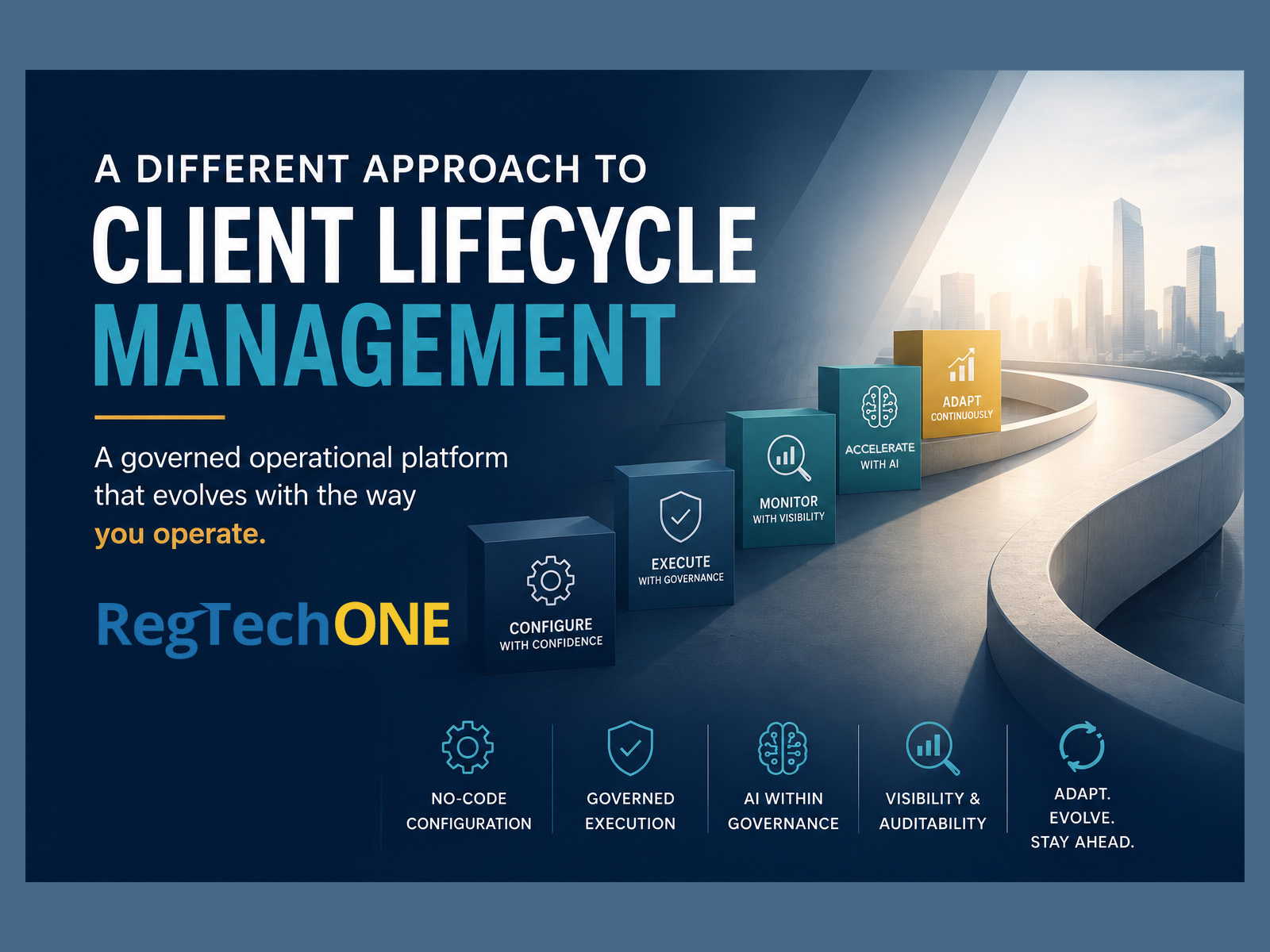
Most Client Lifecycle Management (CLM) platforms were designed to automate compliance processes. RegTechONE, in contrast, helps financial institutions continuously improve them.
That may sound like a subtle distinction, but it changes almost everything.
Over the past decade, financial institutions have invested heavily in onboarding platforms, Know Your Customer (KYC) solutions, Customer Due Diligence (CDD), workflow automation, and a growing collection of compliance technologies.
Those investments have improved efficiency, but they’ve also exposed a different challenge. Regulations, products, risk models, AI and agents, risk appetites–they are all changing, sometimes month to month. Contemporary Client Lifecycle Management requires agility to evolve as needs evolve.
Instead of focusing on a static catalog of features, we designed RegTechONE to answer this question: “How can financial institutions continuously evolve the way they operate while preserving governance, transparency, and control?”
Everything about RegTechONE—from its governed no-code architecture to its workflow orchestration and AI-enabled operational framework—flows from that one idea.
We started with the operating model—not the application
Most enterprise software begins with a list of functions. Customer onboarding. Know Your Customer (KYC). Customer Due Diligence (CDD). Sanctions screening. Credit reviews. Case management. Workflow automation.
Those functions are foundational, but they are not what financial institutions actually manage.
Financial institutions manage operating models. They define how work moves through the organization, who approves decisions, how policies are enforced, what evidence is retained, how exceptions are handled, and how regulatory requirements are translated into day-to-day operations. Applications support those activities, but they are not the operating model itself.
That distinction became the foundation of RegTechONE.
Rather than building isolated applications connected by integrations, we built a governed operational platform that allows institutions to express—and continuously refine—their operating model through technology. As regulations, products, risks, and business priorities evolve, the platform evolves with them
Compliance doesn’t change once a year anymore
There was a time when operational change arrived in large, predictable projects. A new regulation would trigger an implementation effort. A merger might require new workflows. A product launch would introduce additional compliance requirements.
Today, change is continuous.
Financial institutions operate in an environment where policies, risk appetites, customer expectations, and technologies evolve throughout the year. And artificial intelligence and agents have accelerated that pace even further. Compliance teams can no longer afford to wait months for operational improvements that should take days.
That is why institutional adaptability became one of the design principles behind RegTechONE.
Instead of treating every operational refinement as a software project, the platform enables governed no-code configuration of workflows, approvals, business rules, and decision logic. Institutions retain governance and auditability while dramatically reducing the cost and effort required to adapt.
Governance should accelerate change—not slow it down
One misconception about operational flexibility is that it comes at the expense of governance. In highly regulated industries, that tradeoff remains unacceptable.
We believe the opposite should be true. The stronger an institution’s governance framework, the more confidently it should be able to evolve.
Within RegTechONE, workflows, approvals, policies, and operational logic remain governed, versioned, transparent, and auditable. Compliance teams can respond more quickly because operational changes occur inside a controlled framework rather than outside of it. Governance becomes the mechanism that enables continuous improvement instead of the reason it cannot happen.
That is what we mean by governed execution.
No-code matters because the business owns the business
The phrase no-code appears on countless technology websites, but the technology itself is not the point. The real question is who owns operational change.
When every workflow adjustment depends on software developers or external consultants, the business inevitably becomes less responsive. Compliance teams understand the operational need, but they often have to wait for technical resources before implementing even modest improvements.
We designed RegTechONE to shift appropriate operational ownership back to the business. Compliance and operations teams can configure processes through governed no-code capabilities while technology teams continue focusing on platform engineering, integrations, security, and complex development.
That balance allows institutions to move faster without compromising governance or architectural integrity.
AI should become part of the operating model
Artificial intelligence and agents are already transforming Compliance operations, but many organizations are still deciding how AI should fit within highly regulated environments.
We believe AI should not exist as a separate layer operating alongside business processes. It should become part of the operating model itself.
Within RegTechONE, AI-enabled capabilities operate inside governed workflows where recommendations, approvals, human oversight, audit trails, and operational controls remain connected. Institutions gain the efficiency and insight AI can provide while maintaining the transparency and accountability regulators expect.
For us, AI is not a feature.nIt is another operational capability that must function within governed execution.
A platform built for continuous evolution
Client Lifecycle Management now extends from prospect management and relationship management (CRM) integration through onboarding, KYC, Customer Due Diligence, credit and risk assessments, sanctions screening, ongoing monitoring, remediation, investigations, and customer offboarding.
Each stage influences the next. Information collected during onboarding informs risk decisions. Monitoring creates investigations. Policy changes affect approvals. AI influences operational decisions. Nothing exists in isolation.
We designed RegTechONE to orchestrate that entire lifecycle through one governed operational environment rather than a collection of disconnected applications. Institutions gain operational consistency, greater visibility, and the ability to evolve the customer lifecycle without repeatedly rebuilding the underlying technology. And we are so confident of the model, that we offer free proof of concept to qualified contacts.
Why we believe this approach matters
The financial institutions that thrive over the next decade will not necessarily be the ones with the longest feature lists or the newest technology. They will be the ones that can adapt more quickly, respond confidently to change, and continuously improve how they operate without sacrificing governance or control.
That belief has shaped RegTechONE from the beginning. We didn’t set out to build another Client Lifecycle Management application. We set out to build a governed operational platform that allows institutions to evolve as regulations, risks, products, and customer expectations continue to change.
Technology should not force financial institutions to redesign their operating model every time the world changes. It should enable that operating model to evolve. We believe that is the future of Client Lifecycle Management, and it is the philosophy that continues to guide the development of RegTechONE.
Frequently Asked Questions: RegTechONE Client Lifecycle Management
RegTechONE was designed as a governed operational platform rather than a collection of individual compliance applications. Instead of simply automating existing processes, it enables financial institutions to continuously adapt workflows, business rules, approvals, and operational logic through governed no-code configuration while maintaining transparency, auditability, and operational control.
Yes. RegTechONE supports the complete client lifecycle—from the transition of a prospect into a customer through onboarding, Know Your Customer (KYC), Customer Due Diligence (CDD), credit and risk assessments, sanctions screening, ongoing monitoring, periodic reviews, remediation, investigations, and customer offboarding.
Governed execution is AML Partners’ approach to ensuring that operational processes remain configurable while preserving governance, transparency, and accountability. Workflows, approvals, business rules, AI-enabled decisions, and policy changes operate within a controlled framework that supports auditability, version control, and regulatory compliance.
No-code matters because it reduces the cost and time required to adapt compliance operations. Rather than relying on software development for every workflow or policy change, business and compliance teams can configure operational processes through governed tools while maintaining institutional oversight and control.
RegTechONE embeds AI within governed operational workflows rather than treating it as a standalone capability. AI recommendations operate alongside business rules, approvals, audit trails, and human oversight, helping financial institutions adopt AI responsibly while maintaining regulatory confidence and operational transparency.
Yes. Because workflows, business rules, and operational logic are configurable, RegTechONE enables financial institutions to support different regulatory requirements, products, business units, and jurisdictions within a single governed operational platform.
RegTechONE was built to solve a challenge that many financial institutions face: compliance operations must continuously evolve, but traditional software often makes change slow, expensive, and dependent on development projects. RegTechONE was designed to help institutions continuously improve the way they operate while preserving governance, transparency, and operational control.
RegTechONE is a Client Lifecycle Management platform built on a governed operational platform. It supports the complete client lifecycle while also enabling financial institutions to orchestrate full AML, workflows, configure business rules, govern AI-enabled operations, and continuously adapt their operating model without repeated software redevelopment.
Read more about Client Lifecycle Management:
How to evaluate Client Lifecycle Management (CLM) Software
Learn the evaluation criteria modern financial institutions should use when selecting a CLM platform.
What makes the best Client Lifecycle Management software?
Discover why architecture, adaptability, and governed execution matter more than feature count.
Explore related topics
What governed execution in AML Compliance actually means
Learn why governance and operational agility are no longer competing priorities—and why governed execution is becoming the foundation of modern compliance.
Why No-Code Compliance is more powerful than you think
Discover how governed no-code configuration allows compliance teams to adapt faster while maintaining control, transparency, and auditability.
Agents at the workflow layer: Why governed execution matters in AML workflow agents
Understand how governed no-code configuration reduces the cost of operational change without sacrificing control.
Your next competitive advantage? Continuous adaptation
See why the ability to evolve compliance operations quickly may become the defining competitive advantage for tomorrow’s financial institutions.