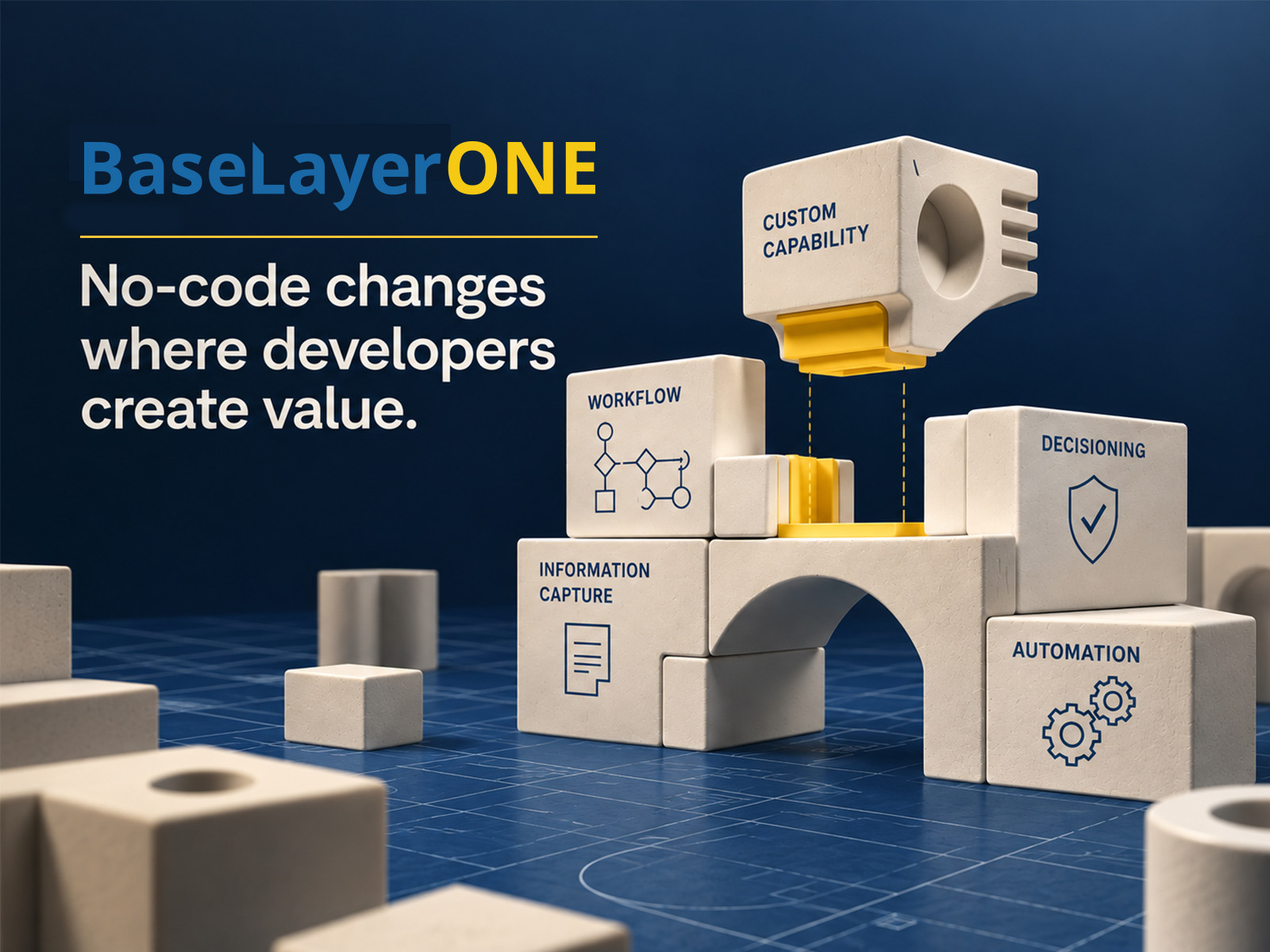
In Brief: The strongest no-code platforms don’t eliminate software development. They change where development creates the most value—allowing developers to build reusable capabilities while business experts configure those capabilities into the processes they understand best.
“No-code” can sound like an argument against developers. It shouldn’t be.
Enterprise applications still depend on serious engineering. Systems need to integrate. Specialized capabilities need to be created. Automation has to interact reliably with other technology. Machine learning models need to perform useful work. And no platform can anticipate every capability that every organization will eventually require.
Clearly, organizations still need developers. But the more compelling point centers on what developers should spend their efforts building for organizations.
BaseLayerONE was designed around a division of labor between two kinds of builders. With BaseLayerONE, business experts model the processes they understand: the workflows, information requirements, rules, decisions, and automation that define how work gets done. That frees developers to extend the platform by creating robust, reusable capabilities that those business builders can then use.
That distinction becomes especially important as automation and machine learning move deeper into operational processes.
Key Idea:
No-code changes the division of labor in application development. Business builders configure what is unique to the process; developers engineer specialized capabilities that can be reused across applications.
Automation belongs inside the workflow
A surprising amount of operational work isn’t really judgment at all.
Someone retrieves information from one system and enters it into another. A document is downloaded. A value is checked against another source. Data is copied into a report. A record is updated because something happened somewhere else.
The work is necessary. But the person performing it often isn’t adding judgment; they’re acting as the connection between systems. Robotic process automation (RPA) allows software to perform many of those repetitive, rule-based actions automatically.
In BaseLayerONE, those automated actions can operate as steps within the same workflow that manages the rest of the business process. That distinction matters.
Rather than treating automation as a separate initiative layered onto an existing process, the process builder can determine where automation belongs while modeling the process itself.
A workflow might capture information from a user, trigger an automated action to retrieve supporting data from another system, route the resulting case to a person for review, and then use another automated action to update a downstream system once a decision has been made.
Human and automated work become parts of the same process model.
That allows organizations to reserve people’s time for the parts of a process that actually require human judgment while software handles work that is predictable and repeatable.
It also keeps that automation within the governed process. The automated action isn’t happening somewhere off to the side. It is part of the workflow and its history.
Machine learning adds learned patterns to explicit business rules
RPA works particularly well when the required action can be defined explicitly. But not every operational judgment can be explicitly defined.
Which cases are most likely to require escalation? Does this transaction resemble previous anomalous activity? How should an unstructured request be classified? Which cases deserve expert attention first?
These are different kinds of questions. Instead of asking software to execute a predefined sequence of mechanical actions, organizations may want it to recognize patterns in historical data and return a prediction, classification, or likelihood. That’s where machine learning enters the process.
BaseLayerONE allows machine learning components and AI agents to be incorporated directly into workflows. An agent can receive information already gathered in the process and return an output that influences what happens next.
That output doesn’t have to become the decision. It might contribute to a risk score. It might determine routing. It might flag a case for review. Or it might provide a recommendation to the person responsible for making the final judgment.
The important architectural point is that the model’s output becomes part of the operational process rather than remaining separate from it. Machine learning becomes useful not simply because a model can make a prediction, but because the organization can put that prediction to work.
Automation, machine learning, rules, and human judgment compose around the business process
Consider a case moving through an end-to-end process.
Dynamic forms capture the relevant information. A machine learning model evaluates the information and returns a likelihood score. A decision or risk engine combines that result with explicit business rules. The workflow uses the resulting assessment to determine the appropriate path.
Clear-cut cases may proceed automatically. Borderline cases may be routed to a person. Higher-risk cases may require enhanced review.
Along the way, RPA actions can retrieve information from other systems or perform repetitive updates that would otherwise require manual effort. And a person steps in where judgment is valuable, with the information and analysis needed to make that judgment.
And equally importantly, the process retains a record of the inputs, predictions, scores, decisions, and automated actions associated with the case.
With BaseLayerONE, the value comes from the composition of the parts into a business-model-aligned whole.
Workflow, information capture, explicit rules, learned patterns, automation, and human judgment aren’t isolated technologies. They are building blocks that can be arranged around the requirements of the business process.
But who builds the building blocks?
Building the building blocks is where the role of developers becomes particularly important.
BaseLayerONE includes workflows, question types, risk engines, RPA actions, and machine learning components as platform capabilities. But no general-purpose platform can ship with every specialized capability that every organization or industry might eventually need. Nor should it try.
Instead of some impossible and static comprehensive tool set, BaseLayerONE uses a plug-in architecture that allows developers to extend the set of capabilities available to application builders.
A developer might create a new machine learning component designed for a particular problem or data type. Another might build a specialized question type for information that standard form controls can’t adequately capture. A developer could create an RPA action that interacts with a system or service specific to a customer’s environment.
Once added to the platform, that capability becomes another building block available to people configuring applications. That creates a multiplier effect.
Instead of writing custom code separately for every application that needs a specialized capability, a developer can engineer the capability once and make it reusable.
The value-added outcome: Build once at the platform layer. Configure many times at the application layer.
No-code is a division of labor
No-code as a division of labor is a distinction that can get lost in conversations about no-code.
The goal isn’t to pretend software engineering is unnecessary. The goal is to stop requiring software engineering for work that doesn’t require it.
A compliance leader who needs to change an approval threshold shouldn’t need a developer to edit application code. An operations manager who needs an additional review step shouldn’t necessarily have to commission a software release. A process owner who wants to route a particular class of cases differently should be able to express that business logic directly within a governed configuration environment.
At the same time, those users shouldn’t be expected to build an integration framework, engineer a specialized machine learning capability, or develop a new reusable component from scratch. That’s developer work.
A platform like BaseLayerONE can create a clean boundary between the two: Business builders configure what is unique to the process, and software developers engineer what should be reusable across processes.
The better that boundary works, the more leverage both groups gain—and the more the organization benefits from effectiveness and efficiency.
Extensibility prevents no-code from becoming a ceiling
Every abstraction creates limits.
A no-code platform that only allows users to assemble whatever its vendor anticipated will eventually encounter a requirement it can’t express. At that point, ease of use becomes constraint.
Extensibility changes that equation.
If an organization encounters a requirement that BaseLayerONE’s existing building blocks don’t address, a developer can create a new one and add it to the platform. The configurable environment becomes more capable without requiring every application builder to become a developer.
Over time, the available palette can grow with the organization. That matters for enterprises, but it also creates another possibility: Developers and software companies can build specialized capabilities—and potentially complete applications—on top of a common platform rather than engineering the underlying application infrastructure themselves.
Their differentiation can live in the domain expertise, logic, integrations, models, and experiences they create.The platform provides the foundation beneath them.
The better question about no-code is where code should live
A common question is whether no-code can replace traditional software development. That’s probably the wrong question.
A more useful one is this: Where should code live?
If a business requirement can be expressed safely through governed configuration, putting that requirement into custom application code may add unnecessary distance between the people who understand the work and the software that executes it.
If a capability requires genuine engineering, developers should build it.
And if that capability can be designed once and reused across many applications, the organization gets far more value from that development effort. That’s the architecture BaseLayerONE is designed to support.
Business experts model and continuously improve the processes they own. Developers extend the foundation beneath them. Automation handles repetitive work. Machine learning contributes prediction where learned patterns add value. Human judgment remains where human judgment matters.
All of it operates within the same application environment.
No-code doesn’t have to push developers out of application development. Done well, it gives them a more valuable layer to build on.
Frequently Asked Questions: Role of developers in a no-code business application platform
No. In BaseLayerONE, no-code changes the division of labor. Business builders can configure workflows and applications, while developers build specialized capabilities that can be reused across applications.
BaseLayerONE uses a plug-in architecture that allows developers to add specialized capabilities when existing building blocks are not sufficient. Once added to the platform, those capabilities can become reusable components available to application builders.
Code is most valuable where genuine engineering is required—for example, to create new integrations, automation capabilities, machine learning components, or other reusable platform services. Business-specific processes can then be assembled through governed configuration rather than custom-coded repeatedly.