Financial institutions rarely design inefficient compliance operations from scratch. They accumulate them.
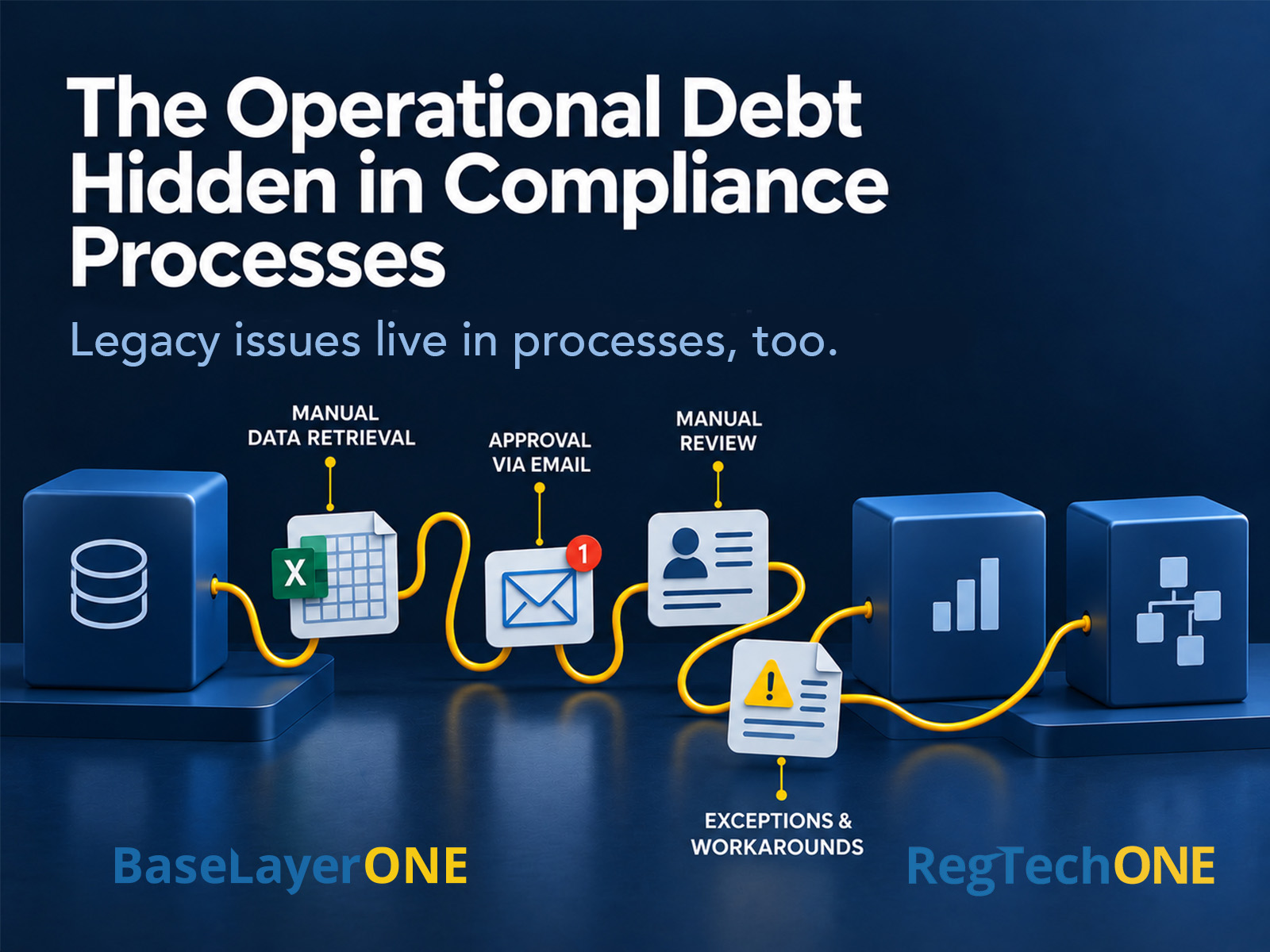
A new regulatory requirement creates an additional review. A system cannot support the review, so the team adds a spreadsheet. An approval requires information from another application, so an analyst retrieves it manually. A specialized exception develops, and an experienced team member learns how to handle it. A temporary workaround solves an immediate problem and gradually becomes standard operating procedure.
Each decision may have made sense at the time. Together, they can create something more consequential: operational debt.
The term has roots in technology operations and is increasingly used more broadly to describe accumulated process and operating constraints. In compliance, it provides a useful lens for the workarounds, fragmented processes, manual interventions, system dependencies, and embedded practices that accumulate over time and make an operation progressively harder to run, control, and change.
Sometimes the legacy problem isn’t the system. It’s the operation that has accumulated around it.
Operational debt accumulates one reasonable workaround at a time
Consider an enhanced due diligence review.
The customer record sits in the KYC system, while screening results come from a separate service. An analyst retrieves additional corporate information from an external data provider and records part of the assessment in a spreadsheet. When the customer meets certain risk criteria, the analyst emails the case to a senior reviewer for approval. Someone then documents that approval in the case record, and selected information may need to be entered elsewhere for ongoing monitoring.
Every application involved may work exactly as intended.
The problem lies in the connections among them: retrieving information, moving data, initiating reviews, documenting decisions, managing exceptions, and making sure the right person knows what to do next.
Similar arrangements develop throughout compliance operations. Spreadsheets supplement systems that do not capture current requirements. Email fills gaps in approval workflows. Analysts rekey information because applications do not exchange the right data. Custom scripts bridge systems. Experienced employees remember exceptions that never became part of the formal process.
No one deliberately designed this operating model. It emerged through years of solving individual problems.
That is why operational debt can be difficult to see. Each workaround looks manageable in isolation. The burden becomes apparent when you examine the end-to-end process.
Operational debt creates control risk, not just inefficiency
Manual effort is the most visible cost of a fragmented process, but for a Chief Compliance Officer it may not be the most important one.
The institution needs to know that the right control occurred, under the right policy, at the right point in the process. It needs to demonstrate who made a decision, what information informed it, which approval applied, and whether the required actions followed.
Fragmentation makes those questions harder to answer.
An approval in an email inbox may have occurred, but can the institution readily connect it to the customer record and the policy that required it? A spreadsheet may contain an important control, but who can change its formulas? An analyst may know that customers meeting a particular condition require additional review, but is that requirement embedded in the operating process or dependent on the analyst remembering it?
The risk becomes more apparent when requirements change. If an institution revises its customer-risk methodology, it must identify everywhere the old methodology has become embedded: system rules, workflows, spreadsheets, procedures, approval practices, reporting logic, manual reviews, and employee routines.
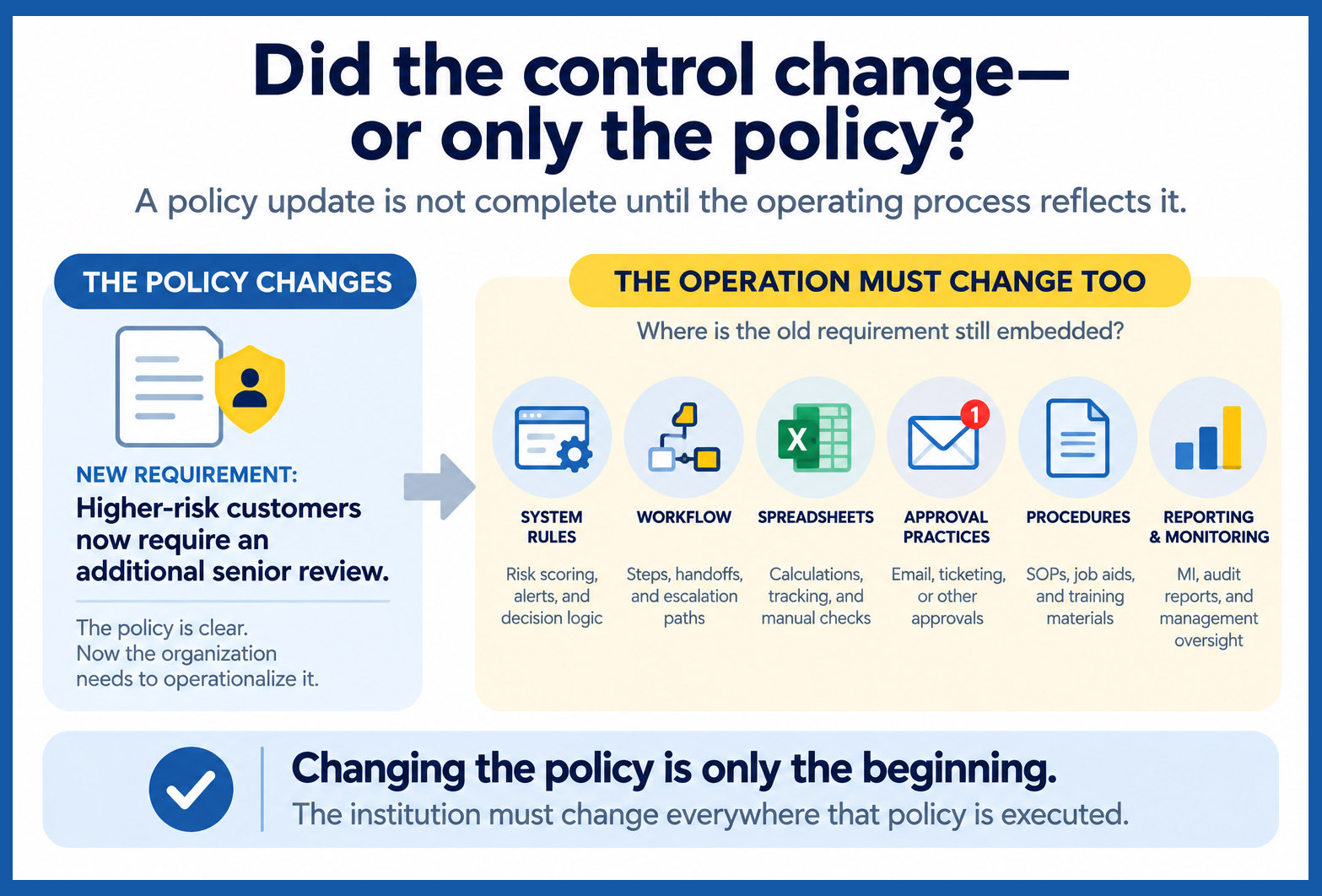
The policy can change before the operation beneath it does.
That creates a consequential question: Did the institution actually change the control, or did it change the policy while pieces of the old process continued operating?
Over time, the difficulty of making these changes can influence the decisions themselves. Teams may know a process should change but hesitate because the change touches too many systems, procedures, integrations, and people.
At that point, yesterday’s solutions have started constraining today’s compliance decisions.
Sometimes the operating process—not the technology—is the legacy
Financial institutions have spent decades investing in specialized technology. Not all of it needs to be replaced.
A sanctions-screening service may perform its function extremely well. So may an identity-verification provider, transaction-monitoring engine, customer database, document service, or core banking system. Replacing a useful system simply because the process surrounding it has become cumbersome can create enormous cost and risk without addressing the real problem.
Return to the enhanced due diligence example. The institution may have no reason to replace its KYC application, screening service, external data providers, or monitoring technology.
The problem may be that analysts have become the integration layer connecting those technologies.
They retrieve information from one place and enter it in another. They determine which procedure applies. They request approvals. They transfer decisions into the official record and make sure downstream actions happen.
The individual technologies may not be legacy systems. The operating process connecting them has become the legacy.
That distinction changes the modernization question. Instead of starting with, “Which systems should we replace?” an institution can ask, “Which parts of this operation should we redesign?”
Modernization can target the operating layer without replacing every system
Once an institution looks at the problem this way, another modernization path becomes possible.
Existing systems and specialized services can continue performing the functions they perform well. The institution can focus instead on where workflow, decision logic, routing, approvals, controls, exceptions, and orchestration should live.
In the EDD process, for example, a governed operating layer could call the appropriate services, assemble information for review, apply the institution’s decision logic, route the case according to risk, manage required approvals, record decisions, and initiate downstream actions.
The analyst no longer needs to serve as the connective tissue among applications. Instead, the analyst can concentrate on work that requires judgment.
This creates a model of governed execution in which controls, decisions, exceptions, and handoffs become explicit rather than remaining scattered across systems and manual practices.
This does not require an institution to redesign its entire compliance environment at once. It can identify a process carrying significant operational burden, examine why each step exists, rationalize the process, and bring its operational logic into a more manageable environment. Then it can address another process.
That is a different model of modernization: progressively reducing operational debt rather than assuming transformation requires replacing everything underneath it.
Automation and no-code only help when the underlying process improves
New technology does not automatically retire old operational debt.
An organization can automate a poorly designed workflow and preserve every unnecessary step. It can connect an old spreadsheet to a new workflow without asking why the spreadsheet exists. It can add an AI capability to a fragmented process and create another dependency without addressing the fragmentation underneath it.
No-code technology presents the same risk. Giving business users the ability to build and change workflows is valuable, but configurability alone does not guarantee a coherent operating model. An organization can reproduce years of accumulated exceptions and workarounds on a newer platform if implementation simply recreates the current state.
The objective should not be to automate everything that exists.
Modernization creates an opportunity to ask harder questions. Why does this review exist? Which policy or risk does it address? Does this approval still add value? Why does an analyst enter this information twice? Which exceptions reflect legitimate business requirements, and which exist because an old system could not support the intended process?
For platforms such as RegTechONE and BaseLayerONE, this is where a governed no-code operating layer matters. More of the institution’s operational logic—workflow, routing, decisions, approvals, controls, exceptions, and orchestration—can become visible, manageable, and changeable without requiring the institution to discard useful underlying systems and services.
The goal is not simply to move an existing process onto newer technology. It is to create a better operating model and give the institution greater ownership of how that model evolves. This larger opportunity is operational ownership: giving authorized compliance teams greater ability to understand, manage, and evolve the processes through which policy is executed.
Good modernization should make the next change easier
Compliance operations do not stand still. Customer risks change. Products and markets change. Regulators identify new concerns. Data sources evolve. Institutions acquire businesses and introduce new systems. AI and other emerging capabilities create new options for how work gets done.
The technology environment may become more sophisticated without becoming simpler.
That makes the ability to change the operation increasingly important.
A modern compliance operation should not be measured simply by how many legacy systems it has replaced or manual tasks it has automated. More important questions are whether the institution can see how the operation works, demonstrate that its controls operate as intended, and change those processes without reconstructing the machinery every time requirements evolve.
Operational debt accumulates when yesterday’s solutions become today’s constraints.
The goal is not to move that debt onto a new platform. It is to progressively retire it–and build an operation in which the next necessary change is easier to make.
Frequently Asked Questions: Operational Debt in Compliance
Operational debt is the accumulated burden of workarounds, fragmented processes, manual interventions, system dependencies, and embedded operating practices that make compliance operations harder to run, control, and change. It often develops gradually as institutions solve individual problems without redesigning the end-to-end process.
Technical debt generally refers to technology choices that create future development or maintenance costs. Operational debt exists in how work actually gets done. It can include manual handoffs, spreadsheets, email approvals, duplicate data entry, undocumented procedures, and dependencies among people and systems. Technical debt can contribute to operational debt, but the two are not the same.
It can, but no-code alone is not enough. Simply recreating a fragmented process on a new platform can preserve the same operational debt. A governed no-code platform can help when an institution first rationalizes the process and then makes workflows, decisions, controls, approvals, and exceptions explicit, manageable, and easier to change.