Search online for the “best” Client Lifecycle Management (CLM) software and you’ll find plenty of product rankings, feature comparisons, analyst reports, and vendor scorecards. Most compare platforms by the number of capabilities they offer, the size of their customer base, or the length of their feature lists. (Click here for a guide on how to evaluate Client Lifecycle Management software.)
Those comparisons can be helpful, but we believe they’re increasingly answering the wrong question.
The real question isn’t which platform has the most features today. It’s which platform will still enable your institution to adapt confidently five or ten years from now.
At AML Partners, we’ve spent years helping financial institutions modernize compliance operations. That experience led us to a simple conclusion: The future of Client Lifecycle Management will not be defined by feature count. It will be defined by architecture. That belief ultimately shaped the design of RegTechONE—a governed, no-code operational platform built to help financial institutions continuously evolve rather than periodically rebuild.
The best CLM platform is not the one with the most features. It’s the one that keeps getting better without requiring the institution to start over.
Key Takeaway: The best Client Lifecycle Management (CLM) software isn’t defined by feature count. It’s defined by how effectively it enables financial institutions to adapt to changing regulations, evolving risks, AI-enabled operations, and new business requirements through a governed, flexible architecture.
Modern Client Lifecycle Management spans the entire customer lifecycle
For years, Client Lifecycle Management was largely viewed as an onboarding challenge. Financial institutions invested in digitizing forms, streamlining Know Your Customer (KYC) processes, and improving customer onboarding experiences. Those investments delivered meaningful value, and they remain essential components of any modern CLM solution.
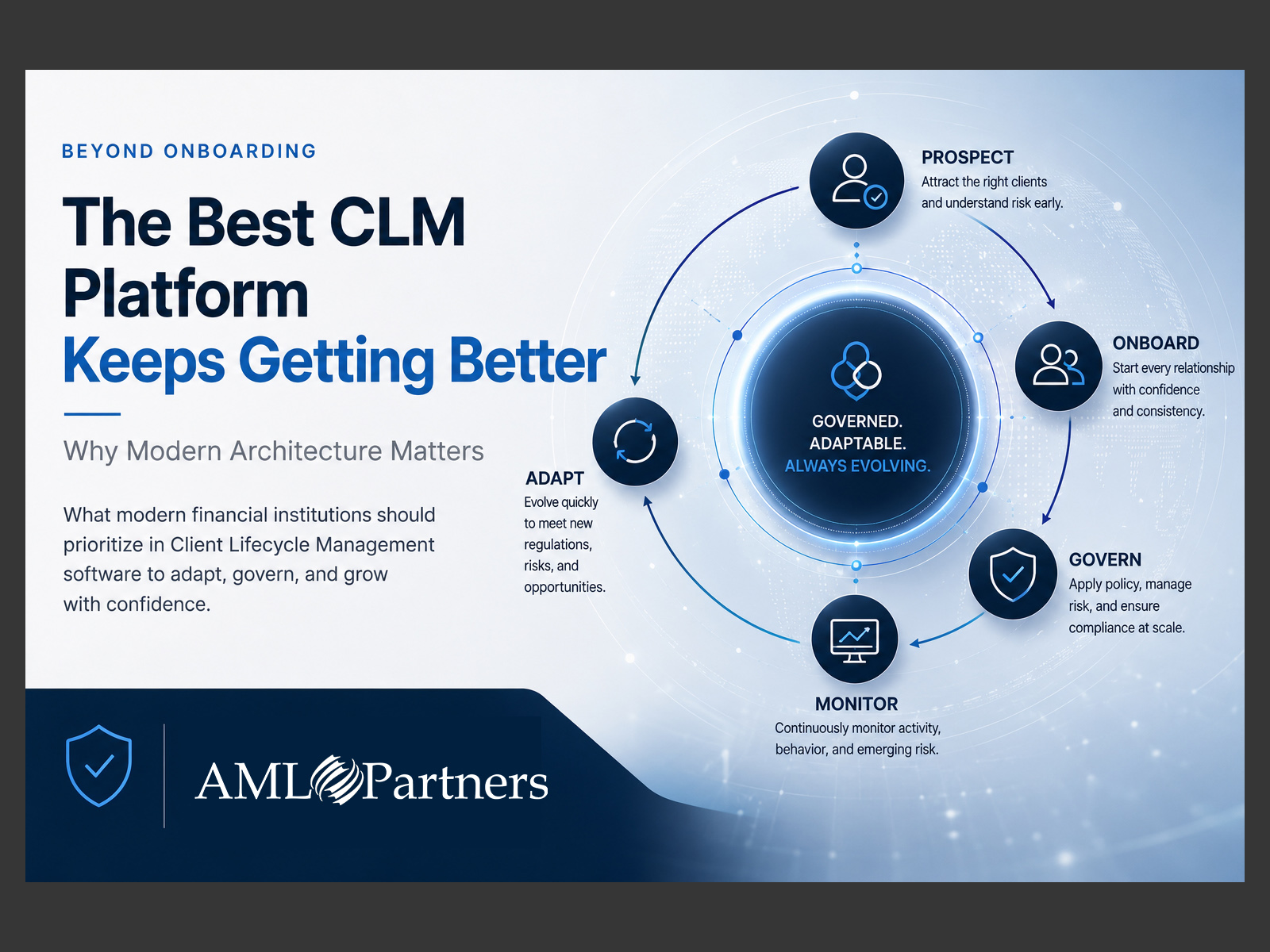
Today’s financial institutions, however, manage a far broader operational lifecycle. CLM now begins with the transition from prospect to customer and extends through onboarding, customer due diligence (CDD), credit and risk assessments, sanctions screening, ongoing monitoring, periodic reviews, remediation, and ultimately customer offboarding.
Managing each of those activities individually is no longer enough. The real challenge is managing them as one connected, governed operating model that can evolve continuously as regulations, business priorities, and customer expectations change.
That is the problem RegTechONE was designed to solve.
The next generation of CLM platforms is built to change as institutions change
One reality defines compliance operations more than any other: Change never stops.
Regulations evolve. Products evolve. Risk appetites evolve. Customer expectations evolve. Artificial intelligence is reshaping operational workflows faster than most institutions anticipated.
Unfortunately, many technology platforms still assume that change is unusual. Operational modifications often become software projects requiring development resources, lengthy testing cycles, and repeated implementation work. Over time, the cost of adapting the platform can exceed the cost of implementing it.
Modern architecture starts with a different assumption: Modern CLM architecture assumes change is constant.
RegTechONE was built around that philosophy. Rather than treating operational changes as redevelopment projects, the platform enables financial institutions to configure workflows, business rules, approvals, and decision logic through governed no-code configuration. Institutions retain complete visibility and control while dramatically reducing the effort required to respond to regulatory and operational change.
That’s more than flexibility. It’s operational resilience.
Business ownership is becoming a competitive advantage
Technology should empower Compliance teams—not create another queue of development requests.
Historically, operational changes often depended on technical teams or external consultants. Even relatively small modifications to workflows or approval processes could require software development and compete with other technology priorities.
Modern CLM platforms are changing that relationship.
RegTechONE enables compliance and operations teams to own much of their operational environment through governed no-code configuration. Business users can adapt workflows, introduce new approval paths, refine decision logic, and respond to policy changes while preserving testing, governance, version control, and complete auditability.
That balance is important. The goal is not to eliminate governance. The goal is to move governance closer to the business while maintaining institutional control.
AI without governance is simply another risk
Artificial intelligence has become one of the defining technology conversations in financial services. It should also become one of the defining governance conversations.
Many platforms now promote AI capabilities. The more important question is how AI operates inside the institution’s operational environment. Can recommendations be reviewed? Can decisions be explained? Can exceptions be managed consistently? Can institutions demonstrate exactly how AI influenced an operational outcome?
These questions cannot be answered by AI alone. They are answered by architecture.
Within RegTechONE, AI operates inside governed operational workflows rather than alongside them. Human oversight, approvals, audit trails, business rules, and operational controls remain integral to every process. AI becomes another governed capability—not an isolated technology feature. That distinction allows institutions to embrace innovation while preserving regulatory confidence.
The strongest CLM platforms orchestrate the entire customer lifecycle
Customer lifecycle management has become significantly more complex than onboarding automation.
Every customer interaction creates operational consequences. Customer onboarding influences risk assessment. Risk assessment influences due diligence. Due diligence influences monitoring. Monitoring generates investigations. Investigations trigger remediation. Every decision influences the next stage of the customer relationship. Managing these activities through disconnected applications creates operational friction and inconsistent customer experiences.
RegTechONE approaches the challenge differently. Rather than treating onboarding, KYC, due diligence, sanctions screening, credit risk, remediation, and offboarding as separate applications, RegTechONE orchestrates them within a single governed operational environment. Data, workflows, approvals, policies, and AI-enabled processes work together as part of one continuously evolving operating model.
That orchestration reduces complexity while improving governance, transparency, and operational consistency.
Why architecture has become the real competitive advantage
Feature lists eventually become similar. Architecture does not.
The underlying architecture determines how easily financial institutions can respond to regulatory change, expand into new jurisdictions, introduce new products, integrate artificial intelligence, and continuously improve operations without repeated redevelopment.
This is why we believe the conversation around Client Lifecycle Management is changing. The most valuable feature a platform can deliver is the ability to evolve. Everything else builds on that foundation.
A different philosophy for Client Lifecycle Management
At AML Partners, we didn’t set out to build another Client Lifecycle Management application. We set out to solve a different problem:
How can financial institutions continuously improve customer lifecycle operations without sacrificing governance, transparency, or operational control?
RegTechONE is our answer.
Its governed no-code architecture enables financial institutions to orchestrate the complete customer lifecycle—from prospect management and CRM integration through onboarding, KYC, customer due diligence, credit and risk assessments, ongoing monitoring, remediation, and offboarding—while allowing operational processes to evolve as quickly as business and regulatory requirements demand.
For institutions preparing for the next decade of compliance, adaptability is no longer a competitive advantage. It has become a necessity.
Frequently Asked Questions: Best Client Lifecycle Management software
The best Client Lifecycle Management software helps financial institutions manage the complete customer lifecycle while supporting continuous operational change. Key capabilities include governed workflow orchestration, business-owned configuration, multi-jurisdiction support, AI-enabled operations, transparency, auditability, and the ability to adapt without repeated redevelopment.
There is no single best platform for every institution. The strongest CLM platforms combine end-to-end lifecycle management with operational adaptability, governed execution, business-owned configuration, workflow orchestration, AI governance, and multi-jurisdiction support. Financial institutions should evaluate how well a platform can evolve over time—not simply its current feature set.
No. Modern Client Lifecycle Management begins with customer acquisition and extends through onboarding, Know Your Customer (KYC), Customer Due Diligence (CDD), credit and risk assessments, sanctions screening, ongoing monitoring, periodic reviews, remediation, and customer offboarding.
RegTechONE approaches Client Lifecycle Management as a governed operational platform rather than a collection of individual applications. Its no-code architecture enables financial institutions to configure workflows, approvals, business rules, and AI-enabled processes while maintaining governance, transparency, and operational control.
Regulations, customer expectations, business priorities, and AI capabilities continue to evolve. Financial institutions increasingly need platforms that can evolve with them, reducing the long-term cost of change while maintaining consistent governance and operational resilience.
Read more about Client Lifecycle Management
How to evaluate Client Lifecycle Management (CLM) Software
Learn the evaluation criteria modern financial institutions should use when selecting a CLM platform.
What makes the best Client Lifecycle Management software? (This article)
Discover why architecture, adaptability, and governed execution matter more than feature count.
A different approach to Client Lifecycle Management: Why we built RegTechONE
Learn why RegTechONE takes a different approach to Client Lifecycle Management by combining governed execution, no-code configuration, and continuous operational adaptability.
Explore related topics
What governed execution in AML Compliance actually means
Learn why governed execution is becoming the foundation of modern compliance operations and AI governance.
Why No-Code Compliance is more powerful than you think
Understand how governed no-code configuration reduces the cost of operational change without sacrificing control.
Your next competitive advantage? Continuous adaptation
The ability to continuously adapt Compliance operations with speed, governance, and confidence is the new expectation with RegTech—and a key competitive advantage.
Agents at the workflow layer: Why governed execution matters in AML workflow agents
Understand how governed no-code configuration reduces the cost of operational change without sacrificing control.